
Most people know about Memphis, Tennessee’s Sun Records and its impressive musical roster of Elvis Presley, Carl Perkins, Johnny Cash, and others, but fewer fans know about Cordell Jackson, the oft forgotten woman behind the famed record label.
Because, in reality, Sam Phillips didn’t create his legendary recording studio out of thin air. Before he established the label on February 1, 1952, he was cutting demos in Jackson’s home with her gear and her know-how.
Videos by American Songwriter
Cordell Jackson, The (Not So) Silent Innovator
Despite her relatively quiet presence in rock and roll history, Mississippi native Cordell Jackson was anything but timid. She picked up guitar, piano, harmonica, and double bass as a child, much to the chagrin of some of her male relatives. “When I picked up the guitar, I could see it in their eyes,” Jackson once said (via her obituary in the New York Times). “I looked right at ‘em and said, ‘I do.’”
Jackson eventually settled down in Memphis, Tennessee, with her husband, William Jackson. She worked as a riveter during WWII and pursued music on the side throughout the late 1940s. Her style of guitar playing was fast, abrasive, and bold—essentially, it was rockabilly before it adopted its name. As she once told The Tulsa World in 1992, “If what I’m doing now is rock n’ roll or rockabilly or whatever, then I was doing it when Elvis was a one-year-old.”
Unfortunately, not even Jackson’s raucous playing was enough to separate her from the world in which she lived. Women simply weren’t cutting rock and roll records at this time. Heartbroken country, sure, but mind-blowing rock instrumentals? Not a chance. This overt sexism within the music industry also led to her estrangement from Sam Phillips and erasure from Sun Records’ founding history.
The Woman Behind Sun Records
Although Cordell Jackson was the one who helped Sun Records founder Sam Phillips cut his earliest demos, when the time came for Phillips to establish his label, he deemed Jackson’s gender too controversial. Sun Records’ roster was entirely dominated by male artists, and consequently, they rejected each of Jackson’s multiple submissions to join the roster she arguably helped create.
RCA Records representative and country musician Chet Atkins encouraged Jackson to do what she did best: push back against the status quo and do it herself. So, that’s precisely what she did. Jackson founded Moon Records (a not-so-subtle reference to the label that rejected her) and served as a producer, engineer, songwriter, and promoter out of her living room studio.
But neither she nor the artists she recorded were as successful as their other Memphis colleagues, and Jackson had to add day jobs to her lengthy to-do list. She worked as an interior decorator, a radio DJ, a junk shop owner, and more to make ends meet.
The Cordell Jackson Revival
Her career saw a stunning resurgence in the 1980s. Jackson, at that point in her golden years, wowed audiences with her diminutive, elderly appearance and ripping guitar playing. During an appearance on the WFMU radio show “The Hound,” host Jim Marshall called Jackson’s playing “some of the most vicious, nasty rock n’ roll guitar I’ve ever heard in my life.” From there, she started to book more on-stage appearances and television cameos in her 60s and 70s.
“I like to say I’m an overnight success, but it’s been a 42-year night,” Jackson said in a 1990 interview. “I’ve had 42 straight years of hard knocks. I was the only woman who even thought of making a record for radio play. I’ve had a lifetime of hearing adults say, ‘Little girls don’t play the guitar,’ but they do. I’m sweet and loving and simple, but there’s a wild side to me.” Jackson died at 81 from pancreatic cancer on October 14, 2004.
Photo by Tannen Maury/EPA/Shutterstock
More Did You Know
-
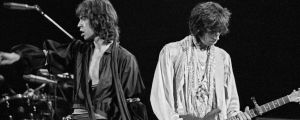
The Rolling Stones in concert, Tour of Europe '76, Earls Court Arena – Mick Jagger and Keith Richards (Photo by Graham Wiltshire/Shutterstock) -

Rock band: The Rolling Stones: – Mick Jagger, Keith Richards (Photo by Roger Bamber/Shutterstock) -

Singer and songwriterJohn Lennon (1940 – 1980) with his wife Yoko Ono, signing copies of her conceptual art book 'Grapefruit' at Selfridges, London, 15th July 1971. (Photo by Jack Kay/Daily Express/Getty Images) -

Despite its fantastical origin story of surviving a shrapnel attack in the Vietnamese jungle, the D-28 met its demise on a flight to Hawaii. Not only did the turbulent flight damage the instrument in storage; someone later stole the guitar from the luggage carousel. Mitchell was never able to find her long-lost instrument, something she’s lamented for years. Aside from the sentimental connection guitarists typically have to their first ax, Mitchell was particularly fond of her Martin for functional reasons. After a bout of childhood polio affected Mitchell’s ability to form chord shapes in standard tuning, the singer-songwriter had to adapt with eccentric tunings that allowed her to create rich harmonic structure with limited mobility. Whether open, an octave below, or otherwise, Mitchell’s unique tunings placed stress on the guitar neck that it wasn’t originally made to endure. Moreover, to ensure the dissonance within her tunings was purposeful and not merely off-pitch, Mitchell needed a guitar with pristine intonation—something she frequently lauded the D-28 for having. “I need really good intonation,” she explained to Acoustic Guitar. “One of the signs of really good intonation is how flashy the harmonics are with a light touch. You should be able to get them to bloom like jewels.” While Mitchell has found other guitars that come close in that department, as she put it in her 1996 magazine interview, “I’ve never found an acoustic that could compare with it.” Photo by Central Press/Hulton Archive/Getty Images -

Drummer Ringo Starr of English rock band the Beatles during a reception at the London home of the group's manager Brian Epstein, 20th May 1967. The Beatles' song 'A Day In The Life' had recently been banned by the BBC for its references to drug-taking. (Photo by John Pratt/Keystone/Hulton Archive/Getty Images) -
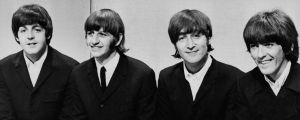
English rock band the Beatles at the BBC television studios in London before leaving for a concert tour of Germany, and afterwards Japan, 16th June 1966. From left to right, they are Paul McCartney, Ringo Starr, John Lennon and George Harrison. (Photo by Central Press/Hulton Archive/Getty Images) -

NEW YORK, NEW YORK – JUNE 11: (L-R) Tommy Thayer, Paul Stanley, Gene Simmons, and Eric Singer of KISS attend the 2021 Tribeca Festival screening of "Biography: KISStory" at The Battery on June 11, 2021 in New York City. (Photo by Monica Schipper/Getty Images)