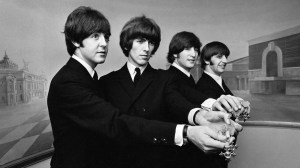
Theirs was one of the most acrimonious intra-band fractures in the history of rock music. Considering that, it’s not all that surprising that a member of Pink Floyd made not-so-subtle commentary on the situation in one of their songs.
But it might surprise you that it was David Gilmour, generally known for his evenhanded nature, who struck the blow. Gilmour’s 1984 solo song “You Know I’m Right” made clear his frustration with Roger Waters, who was soon to be an ex-member of Pink Floyd.
Videos by American Songwriter
Floyd in Flux
Even in the MTV-driven early 80s, a time when most bands who came to fame in the 70s had seen their popularity dim, Pink Floyd still commanded a great deal of attention. Their 1983 album The Final Cut didn’t sell as well as some of their past triumphs. But it still topped the charts in the UK and went to the Top 10 in America.
Around that time, Roger Waters made some comments in the press about how he, David Gilmour, and Nick Mason were no longer a tight unit. He also insinuated he was doing the lion’s share of work within the group and that there would be no Pink Floyd in the future if he moved on from the band.
Eager for new musical challenges, Waters headed into the studio to record his first solo album even before The Final Cut was released. But he wasn’t the only one making that move. David Gilmour did the same. And one of the songs that he worked up during those sessions left a pointed message for Waters.
“Right” Angle
Gilmour surrounded himself with top studio musicians like Pino Palladino and Jeff Porcaro on About Face, the solo record he released in 1984. Pete Townshend added lyrics for a couple of tracks on the record. Aside from that, Gilmour, who hadn’t written lyrics for Floyd in more than a decade, handled the words.
On “You Know I’m Right”, Gilmour decided to address the Waters situation head-on. Gilmour’s point was that he felt Waters was so intractable that he wouldn’t pay any heed to other points of view. At one point, he sings, “You know you’re right, and that’s absurd.”
“You always have to disagree,” he charges. “It’s just a matter of opinions/It’s not a simple fact.” Gilmour seems willing to meet at some common ground, but he can’t get his musical partner to capitulate. “Don’t turn your back,” he pleads.
Regrets Down the Road
In later years, Gilmour regretted going there with “You Know I’m Right”. In a 2015 interview with Mojo (as reported by Songfacts), he explained why he had second thoughts:
“You are tempted to allow yourself to let those grumbles surface in things. I think it’s generally a poor idea. And if I went back to it, I probably wouldn’t do that. It’s impossible not to grumble and moan about the inequalities and injustices of life (laughs).”
In any case, the fissure exposed in “You Know I’m Right” soon grew to a chasm. After a wave of lawsuits and recriminations aired out in the press, Roger Waters left Pink Floyd for good in 1985. David Gilmour took the lead from there and kept the band afloat through a series of subsequent albums and tours.
(Photo by Jeffrey Mayer/WireImage)
More Features
-
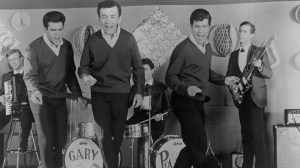
OS ANGELES – 1965: 60's rock band "The Rip Chords" are backed up by Gary Lewis and the Playboys in the beach film "A Swingin' Summer" in 1965 in Los Angeles. (Photo by Michael Ochs Archives/Getty Images) -
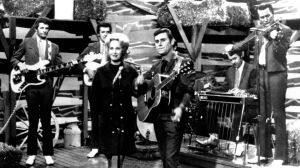
Tammy Wynette and George Jones Perform on stage with the Jones Boys in circa 1972. (Photo by Michael Ochs Archives/Getty Images) -

Kate Bush en concert au théâtre des Champs-Elysées à Paris le 6 mai 1979 (Photo by Jean-Louis URLI/Gamma-Rapho via Getty Images) -

(MANDATORY CREDIT Koh Hasebe/Shinko Music/Getty Images) Randy VanWarmer live at Nakano Sunplaza Hall, December 5, Tokyo, Japan. (Photo by Koh Hasebe/Shinko Music/Getty Images) -
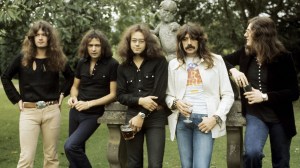
Photo by Armando Gallo/Getty Images -
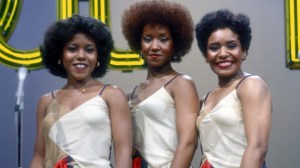
LOS ANGELES – AUGUST 1977: R and B group The Emotions (L-R Pamela Hutchinson, Wanda Hutchinson and Sheila Hutchinson) pose for a portrait on the set of the TV show 'Soul Train' in August 1977 in Los Angeles, California. (Photo by Michael Ochs Archives/Getty Images)