
How do you build a solo career when you’re coming from one of the most momentous bands in rock and roll history? Robert Plant faced that dilemma in the 80s after Led Zeppelin called it quits at the start of the decade.
Plant eventually found his footing, largely by steering away from his former band’s signature sound. His first US Top 40 hit used techniques that Led Zep probably never would have considered.
Videos by American Songwriter
Leaving the Led Behind
The death of John Bonham in September 1980 essentially put an end to Led Zeppelin. The three living members (Robert Plant, Jimmy Page, and John Paul Jones) didn’t deliberate very long before announcing that they were disbanding. They were unwilling to continue without Bonham in the mix.
As the lead singer of the band, Robert Plant entered the next stage of his musical career with considerable notoriety surrounding him. He knew instinctively that trying to wake up the echoes of his former band would be a bad idea. Anyway, there were new horizons he wanted to pursue.
He spent 1981 on the sidelines for the most part, save for occasionally playing live with a new, somewhat loosely constructed group called The Honeydrippers, who focused on covers of old rock and blues songs. He decided to jump back into the original music game the following year with Pictures At Eleven, his first post-Zeppelin solo album.
‘Moments’ to Remember
Pictures At Eleven came off as a bit tentative. Plant still occasionally steered the proceedings into quasi-hard rock territory, as if to placate the fans who expected it of him. He also had to navigate something a bit new. Whereas Zeppelin mostly shunned singles releases, Plant would now be judged by how his songs performed on the radio.
In 1983, Plant returned with The Principle Of Moments, an album that sounded much further removed from his Zeppelin past. The tempos were more measured, the open spaces between the instruments vaster, and the lyrical motifs a tad more contemplative.
On much of the album, Plant used Phil Collins on drums. But on the song that he chose for the album’s first single, there was no drummer at all, at least not a human one. Plant embraced the modern era by using a drum machine’s steady patter as the rhythmic pulse for “Big Log”.
Something “Big”
Jezz Woodroffe, who handled synths and keyboards on The Principle Of Moments, programmed the beat for the song to get it rolling. Robbie Blunt, who acted as the guitar foil for Plant on the album much as Jimmy Page once did on Zeppelin records, developed a moody melodic thrum to go along with it.
From there, Plant came up with lyrics that hinted at the impossibility of love between two nomadic souls. “My love is in league with the freeway,” he moans at the beginning of the song. Plant named the song “Big Log” in a nod to the fireplace that was burning as it was composed.
Even though it resembles a moody album cut more than an attempt to court radio, “Big Log” caught fire (excuse the pun) and made it to No. 20 in the US, while also scaling the heights in the UK. The rumblings of thunder from his former band had finally subsided. With this song as catalyst, Plant could now focus on catching musical lightning in a bottle as a solo act.
(Photo by Jon Super/Redferns)
More Behind The Song
-
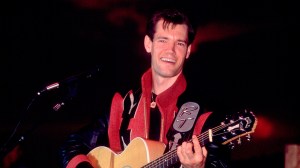
American Country musician Randy Travis plays guitar as he performs onstage at the Wisconsin State Fair, Milwaukee, Wisconsin, July 15, 1988. (Photo by Paul Natkin/Getty Images) -
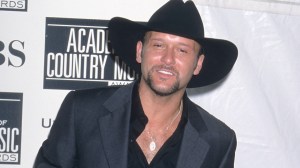
UNIVERSAL CITY, CA – MAY 3: Singer Tim McGrawl attends the 35th Annual Academy of Country Music Awards on May 3, 2000 at the Universal Amphitheatre in Universal City, California. (Photo by Ron Galella, Ltd./Ron Galella Collection via Getty Images) -
American country and western music singer Collin Raye performs at the Rialto Theater in Joliet, Illinois, November 25, 1996. (Photo by Paul Natkin/Getty Images) -
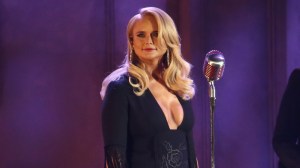
NASHVILLE, TN – NOVEMBER 08: (FOR EDITORIAL USE ONLY) Miranda Lambert performs onstage during the 51st annual CMA Awards at the Bridgestone Arena on November 8, 2017 in Nashville, Tennessee. (Photo by Terry Wyatt/FilmMagic) -
English pop group The Moody Blues, group portrait, 1972, (L-R) Mike Pinder, Justin Hayward, John Lodge, Ray Thomas and Graeme Edge. (Photo by Michael Putland/Getty Images) -
MINNEAPOLIS – AUGUST 3: Prince performs a benefit concert for the Minnesota Dance Theatre at First Avenue nightclub in Minneapolis, Minnesota on August 3, 1983. (Photo by Jim Steinfeldt/Michael Ochs Archives/Getty Images) -
LOS ANGELES – 1974: Singer Joni Mitchell performs in 1974 in Los Angeles, California. (Photo by Donaldson Collection/Michael Ochs Archives/Getty Images) -
DETROIT, USA – 1st FEBRUARY: Gary Wright performs live on stage in Detroit, Michigan in February 1976. (Photo by Fin Costello/Redferns)