
It’s the 21st century.
That means, of course, that no one really pays for recorded music. Long gone are the days when a myriad of bands would sell tens of millions of albums with a given release. Now, the most that bands (read: 99%) can hope for is to earn that many streams, which, of course, we all know equates to mere fractions of pennies on the dollar. For reference, check this hand-dandy stream chart here.
Videos by American Songwriter
So, how do most bands make money?
Two ways, really: live performance and merchandise sales (read: t-shirts, buttons, hats, and the like).
But there is an issue with the latter. Today, many venues require bands to pay them a percentage of their merchandise sales. Often, from headliners to opening acts, the split is 20/80—meaning, for every dollar a band makes selling a t-shirt, the venue gets 20 cents.
At face value, this might make sense to most people. The venue is providing the space that allows fans to attend a show and fans are the ones buying merchandise, so, for that, the venues should make a bit extra. Right? There is a partnership between the bands and the venue starting with ticket sales, and so, the same should be applied to merch then, no?
Why shouldn’t there also be a deal when it comes to merchandise sales, too?
But by digging a little deeper, or applying that same idea to other items sold on the night of a given show, the disparity becomes a bit more clear. Julia Shapiro, a soloist and a prominent member of bands like Chastity Belt and Childbirth, points it out clearly and succinctly.
Writes Shapiro, who is currently on tour with Kurt Vile, in a recent tweet, “if the venue is taking merch cuts, bands should be able to take cuts from the bar.”
She adds, responding to the question, “Don’t venues rely on that money to survive? We’ve lost so many”: “bands rely on that money to survive. and there would be no venues without bands.”
Indeed, if there is a partnership between the venue and the acts to attract people to a certain space and that partnership equates to the splitting of sales on goods and services, why aren’t bands given a percentage of drink (and food) sales? There would be no alcohol or food sales without fans of a band wanting to hear live music, right?
Ticket sales are split. Merch sales are split. But food and drinks are not? Is this fair? For Shapiro—and likely many more bands, tour managers, and more—it’s not.
What are your thoughts? Let us hear them below.
Photo by Gettyimages.com
More Latest Music News & Stories
-
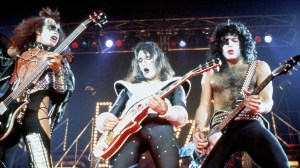
CIRCA 1977: Members of the rock and roll band Kiss perform onstage in circa 1977. (Photo by Michael Ochs Archives/Getty Images) -
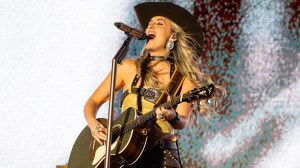
CHICAGO, ILLINOIS – JULY 10: Lainey Wilson performs during the Windy City Smokeout on July 10, 2026 in Chicago, Illinois. (Photo by Barry Brecheisen/Getty Images) -
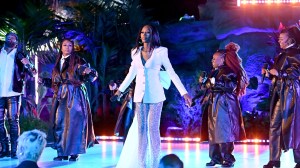
BEVERLY HILLS, CALIFORNIA – NOVEMBER 19: In this image released on November 26, Muni Long performs onstage at Soul Train Awards 2023 on November 19, 2023 in Beverly Hills, California. (Photo by Paras Griffin/Getty Images for BET) -

CHICAGO, ILLINOIS – AUGUST 02: Stella Lefty performs onstage during Lollapalooza at Grant Park on August 02, 2026 in Chicago, Illinois. (Photo by Joshua Applegate/WireImage) -
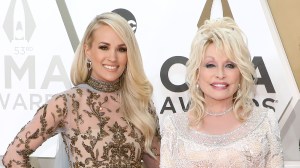
NASHVILLE, TENNESSEE – NOVEMBER 13: (FOR EDITORIAL USE ONLY) Carrie Underwood, Dolly Parton, and Reba McEntire attend the 53nd annual CMA Awards at Bridgestone Arena on November 13, 2019 in Nashville, Tennessee. (Photo by Taylor Hill/Getty Images) -
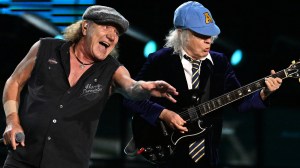
ATLANTA, GEORGIA – AUGUST 27: Brian Johnson and Angus Young of AC/DC perform onstage during the "Power Up" tour at Mercedes-Benz Stadium on August 27, 2026 in Atlanta, Georgia. (Photo by Paras Griffin/Getty Images) -
Photo by Terry Wyatt/WireImage