
When one thinks of the straight-laced, proper environment that is British Parliament, one doesn’t often think of psychedelic rock ‘n’ roll. The two concepts seem almost oxymoronic when smushed together, but Pink Floyd found a way to make it work with their 1994 album, The Division Bell.
Though not a concept album in its truest sense, the English rock ‘n’ rollers’ fourteenth studio album centers mainly around communication. The album cover features two profiles facing one another with open mouths, as though they were talking to one another. Look at the image in a different way, and those two halves form a single face. Interestingly, despite its cohesive imagery, the band had the artwork before they settled on an official title.
Videos by American Songwriter
For that, Pink Floyd—or, perhaps more accurately, author Douglas Adams—turned to a centuries-old practice still upheld in the U.K. today.
The Meaning Behind Pink Floyd’s 1994 Album Title, ‘The Division Bell’
In a parliamentary context, division bells refer to the chimes rung to indicate that a vote, or division, is taking place in Parliament. The bells inform members of the House of Commons and the House of Lords that they have eight minutes to get to their division lobby and cast their vote. Division bells are scattered throughout the Houses of Parliament and in the surrounding neighborhood, including local pubs, shops, and eateries where members might be taking a break from their duties. Some high-ranking officials even have division bells hardwired into their residential homes.
For Douglas Adams, the idea to use “Division Bell” for the Pink Floyd album seemed obvious. To start, David Gilmour already included the phrase in the final track off the then-untitled album, “High Hopes”.
“Beyond the horizon of the place we lived when we were young, in a world of magnets and miracles / Our thoughts strayed constantly and without boundary / The ringing of the division bell had begun / along the Long Road and on down the Causeway.”
“Dave Gilmour asked me to fiddle around some of the album lyrics, which I did,” Adams recalled, per Andy Mabbett’s The Complete Guide To The Music Of Pink Floyd. “I didn’t think up the [album] title, of course. I merely pointed out that the phrase was lying there in one of the song lyrics and would make a great title. Dave was a bit preoccupied with the title problem. They had to have the title by the following morning, and no one could decide what it should be.”
Adams joked with Gilmour that he would offer his idea, but only if Gilmour contributed five thousand pounds to the Environmental Investigation Agency. “Dave said, ‘Well, tell me what your title is, and we’ll see.’”
Thus, the Vote Was Cast
When Douglas Adams told David Gilmour his proposed title, The Division Bell, the guitarist was receptive. “Dave said, ‘Hmmm, well, seems to work. Sort of fits the cover art as well. Yeah. Okay,’” Adams recalled. (This album is yet another example of art taking on new metaphorical meanings after the fact, as it seems like the artwork for The Division Bell and the title itself were thought of simultaneously.)
The March 1994 release of The Division Bell coincided with an international tour, which made around $100 million. The album itself was a success, topping the charts in the U.K., U.S., and elsewhere. Although The Division Bell often pales in comparison to some of Pink Floyd’s earlier works, the public cast their division in support of the band’s second album, sans Roger Waters, clearly in the mid-1990s.
Photo by Sobli/RDB/ullstein bild via Getty Images
More Behind the Album
-

Photo by Ed Rode/Getty Images -
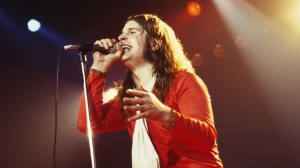
Photo by Chris Walter/WireImage -
Photo by Ed Rode/Getty Images -
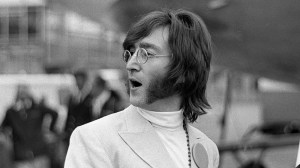
Photo by Murphy/Daily Herald/Mirrorpix via Getty Images -
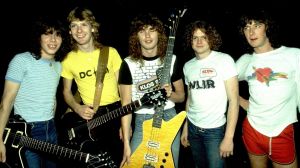
Def Leppard on 8/23/81 in East Troy, Wi. (Photo by Paul Natkin/WireImage) -
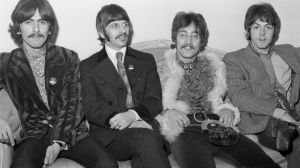
LONDON – MAY 19: (L-R) English musician, singer, songwriter and guitarist George Harrison (1943-2001), English musician, singer and drummer Ringo Starr, English singer, songwriter and guitarist John Lennon (1940-1980), and English singer, songwriter and bassist Paul McCartney of the Beatles attend a press party at the home of manager Brian Epstein supporting the release of Sgt. Pepper's Lonely Hearts Club Band, May 19, 1967 in London, United Kingdom. (Photo by Jeff Hochberg/Getty Images) -
UNITED KINGDOM – JANUARY 01: MARQUEE Photo of VANILLA FUDGE, performing live onstage – L-R: Mark Stein, Vince Martell, Carmine Appice, Tim Bogert (Photo by Estate Of Keith Morris/Redferns) -
CIRCA 1966: Singer Mick Jagger of the rock and roll band "The Rolling Stones" performs onstage in circa 1966. (Photo by Michael Ochs Archives/Getty Images)