
Following the death of drummer John Bonham, Led Zeppelin opted to no longer continue without their beloved bandmate and friend—a highly respectable decision, but one that forced Jimmy Page to lie to their record label when producing what would become one of Led Zeppelin’s most divisive albums. Given the context in which Page created the record, it’s unsurprising it’s among fans’ least favorites.
Nevertheless, Page upheld his band’s end of their record contract in an impressive feat of production skills and overwhelming musicality.
Videos by American Songwriter
An Obligation to Atlantic
Having a rotating lineup of backing instrumentalists is certainly not a rarity in the music world, but for Led Zeppelin, it was the original lineup or no lineup at all. Thus, when John Bonham tragically died at 32 years old in 1980, the English rock band decided they could no longer continue as if nothing had happened. But there was one problem: Led Zeppelin was contractually obligated to produce one more record for their label, Atlantic Records.
Thus, Coda was born. As Jimmy Page explained to Radio.com, “Coda had to be put together. It was a sort of ‘we owed the record company another’ album. I don’t even know how Peter Grant [Led Zeppelin’s late manager] managed to breach the subject to me. It was quite a while after we’d lost John. But to me, it still felt like we’d just lost him yesterday. So, it was a difficult album to put together.”
Piecemealing Coda together was a challenge from both an emotional and production standpoint. Fortunately, Page’s time cutting his teeth as a session player in the 1960s paid off, and he was able to use overdubs, past live performances, and other outtakes to compile what would become the band’s 1982 release.
The White Lie Jimmy Page Told Atlantic Record Label
Without John Bonham, Jimmy Page had to compile a Led Zeppelin record out of scrap material. Throughout the musical hodge-podge, Page used “Bonzo’s Montreaux” as Coda’s backbone. Page told Radio.com the track “was recorded between Presence and In Through the Out Door. I’d worked on it with John. The other members weren’t there. Under the circumstances, there couldn’t be anything better than having a drum orchestra of John Bonham.”
Even with a backbone off which Page could build the rest of the record, he ran into yet another issue. Atlantic wanted a studio album, not a live compilation. So, Page decided to tell a little white lie to the label. “The earliest pressings of Coda included the information that “We’re Gonna Groove” was recorded at London’s Morgan Studios on June 25, 1969,” the liner notes for Centennial Media’s Legends of Music Spotlight: Led Zeppelin explained (via CheatSheet).
“In reality, as was noted on subsequent releases of the album, the song was culled from a January 9, 1979, live performance at London’s Royal Albert Hall. Jimmy Page didn’t make a mistake,” the notes continued. “This was his sleight of hand. The contract with Atlantic called for a studio album. Lacking enough material for one, the guitarist cleverly doctored the live performance to make it sound like it was done at Morgan.”
Many fans place Coda at the bottom of their list of favorite Led Zeppelin albums. This makes sense, all things considered. The album itself was a mish-mash of different eras of the band. It wasn’t a group or creatively cohesive effort like their previous works. However, that small lie Jimmy Page told the record label helped him and his surviving bandmates fulfill their contract without disrespecting the memory of John Bonham.
Photo by Ian Showell/Keystone/Getty Images
More Behind the Album
-

Photo by Ed Rode/Getty Images -
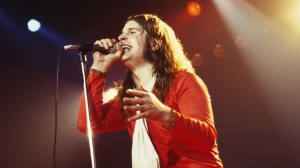
Photo by Chris Walter/WireImage -
Photo by Ed Rode/Getty Images -
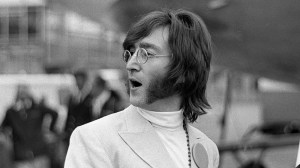
Photo by Murphy/Daily Herald/Mirrorpix via Getty Images -
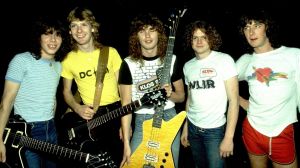
Def Leppard on 8/23/81 in East Troy, Wi. (Photo by Paul Natkin/WireImage) -
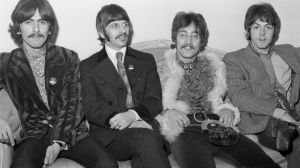
LONDON – MAY 19: (L-R) English musician, singer, songwriter and guitarist George Harrison (1943-2001), English musician, singer and drummer Ringo Starr, English singer, songwriter and guitarist John Lennon (1940-1980), and English singer, songwriter and bassist Paul McCartney of the Beatles attend a press party at the home of manager Brian Epstein supporting the release of Sgt. Pepper's Lonely Hearts Club Band, May 19, 1967 in London, United Kingdom. (Photo by Jeff Hochberg/Getty Images) -
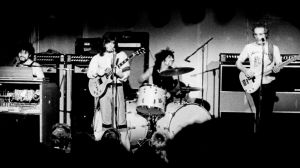
UNITED KINGDOM – JANUARY 01: MARQUEE Photo of VANILLA FUDGE, performing live onstage – L-R: Mark Stein, Vince Martell, Carmine Appice, Tim Bogert (Photo by Estate Of Keith Morris/Redferns) -
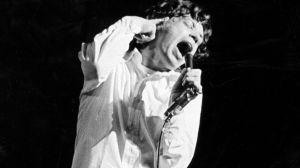
CIRCA 1966: Singer Mick Jagger of the rock and roll band "The Rolling Stones" performs onstage in circa 1966. (Photo by Michael Ochs Archives/Getty Images)