Rock music certainly doesn’t have the impact it once did on the Billboard Hot 100. In fact, you’d have to go back more than 25 years for the last time a classic rock act had a No. 1 hit on the U.S. pop singles tally. That was in 2000, when Santana topped the Hot 100 with “Maria Maria,” a collaboration with hip-hop duo The Product G&B.
That being said, from the 1960s until 1990, rock singers and bands fairly regularly reached No. 1 on the chart. In 1971, for example, quite a few hits that remain rock classics today landed on top of the Hot 100.
Videos by American Songwriter
[RELATED: 4 Classic Rock Artists Who Scored No. 1 Hits on the Billboard Hot 100 in 1977]
Here’s a look at four of those songs.
“My Sweet Lord” by George Harrison
The Beatles announced their breakup in April 1970, and guitarist George Harrison released his first post-Fab Four solo album, All Things Must Pass, in November of that year.
The triple album’s lead single, and Harrison’s first-ever solo single, was “My Sweet Lord.” George originally gave the hypnotic, spiritual-themed tune to R&B/gospel keyboardist and Beatles collaborator Billy Preston, who released it on his own 1970 solo album, Encouraging Words.
Harrison’s version, which featured elements of folk-rock and gospel, was an immediate hit. It soared to No. 1 on the Hot 100 on December 26, 1970, making George the first former Beatle to top the U.S. singles chart. “My Sweet Lord” remained at No. 1 for the first three weeks of 1971.
The song brings together Western and Eastern spirituality, with George incorporating the mantra chants of “Hallelujah” and “Hare Krishna.”
In 1971, Harrison was sued for plagiarism by Bright Tunes Music publishing company, which claimed the rock song sounded too much like “He’s So Fine”, a hit for The Chiffons. During a trial, George claimed the actual inspiration for “My Sweet Lord” was “Oh, Happy Day,” a gospel tune that was in the public domain. Harrison eventually lost the case, with the judge ruling that the rock legend was guilty of “subconscious plagiarism.”
“My Sweet Lord” remains Harrison’s best-selling solo single. The song was inducted into the Grammy Hall of Fame in 2014. In December 2024, it was Certified Double Platinum by the RIAA for equivalent sales of two million copies in the U.S.
“Me And Bobby McGee” by Janis Joplin
Legendary blues-rock singer Janis Joplin died of a drug overdose in October 1970 at the age of 27. Her final studio album, Pearl, was released posthumously in January 1971.
Pearl included a cover of Kris Kristofferson’s country-folk classic “Me And Bobby McGee,” which Joplin recorded just a few days before her death. The song tells the fictional tale of a love affair between two drifters.
Joplin’s rock version of “Me And Bobby McGee” topped the Hot 100 on March 20, 1971, and spent two weeks at No. 1.
In 1972, Janis was posthumously nominated for a Grammy in the Best Pop Vocal Performance, Female category for “Me And Bobby McGee.” Her rendition was inducted into the Grammy Hall of Fame in 2002.
“Uncle Albert/Admiral Halsey” by Paul & Linda McCartney
Paul McCartney collaborated with his wife, Linda, on his second post-Beatles album, Ram, which was released in May 1971.
The first single released from Ram was “Uncle Albert/Admiral Halsey,” a whimsical, multi-part tune reminiscent of some of the Fab Four’s inventive late-1960s work.
The track features a string arrangement by longtime Beatles producer George Martin.
The song became Paul’s first solo No. 1 hit, topping the Hot 100 for one week in September 1971.
“Maggie May” by Rod Stewart
Rod Stewart released his third solo album, Every Picture Tells a Story, in May 1971. At the time, Stewart also was recording and touring with British rock group the Faces.
The album included “Maggie May,” which became Rod’s breakthrough hit, and is considered his signature tune. Stewart co-wrote the song with guitarist Martin Quittenton, a member of the British blues-rock group Steamhammer.
Stewart’s lyrics to “Maggie May” were inspired by losing his virginity to an older woman at a blues festival.
Faces members Ronnie Wood and Ian McLagan both contributed to the track. Wood played electric guitar, twelve-string guitar, and bass while McLagan played Hammond organ. The tune also features mandolin solos by Ray Jackson, a member of the folk-rock group Lindisfarne.
The song initially was released as the B-side to Stewart’s cover of the Tim Hardin song “Reason To Believe.” Radio stations began turning the disc over and playing “Maggie May” instead of “Reason To Believe.”
The rock tune “Maggie May” reached No. 1 on October 2, 1971. It held onto the top spot for five weeks.
In 2017, “Maggie May” was inducted into the Grammy Hall of Fame. In 2021, the song was certified two-times Platinum by the RIAA for equivalent sales of 2 million copies in the U.S.
(Photo by Tim Boxer/Getty Images; Photo by Estate Of Keith Morris/Redferns/Getty Images)
More The List
-
LOS ANGELES – AUGUST 1977: R and B group The Emotions (L-R Pamela Hutchinson, Wanda Hutchinson and Sheila Hutchinson) pose for a portrait on the set of the TV show 'Soul Train' in August 1977 in Los Angeles, California. (Photo by Michael Ochs Archives/Getty Images) -
Bob Dylan (b. 1941) the cult American singer and songwriter, best known for his folk protest music during the 1960's. (Photo by © Hulton-Deutsch Collection/CORBIS/Corbis via Getty Images) -
THE TONIGHT SHOW WITH JAY LENO — Tim McGraw — Air Date 05/15/2003 — Episode 2490 — Pictured: (l-r) Musical guest Tim McGraw performs on May 15, 2000 (Photo by Paul Drinkwater/NBCU Photo Bank/NBCUniversal via Getty Images via Getty Images) -
MEXICO CITY, MEXICO – OCTOBER 27: Singer Steven Tyler of Aerosmith performs onstage at Arena Ciudad de Mexico on October 27, 2016 in Mexico City, Mexico. (Photo by Victor Chavez/WireImage) -
Photo by Jack Robinson/Getty Images -
NITED STATES – JANUARY 01: Photo of Joe COCKER; Joe Cocker performing on stage (Photo by Robert Knight Archive/Redferns) -
INGLEWOOD, CA – NOVEMBER 07: Gregg Allman live in concert with the Allman Brothers Band at The Forum on November 7, 1974 in Inglewood, California. (Photo by Jeffrey Mayer/Getty Images) -
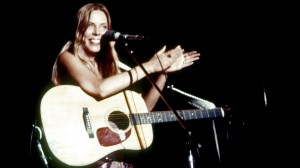
BERKELEY, CA – MARCH 1: Joni Mitchell performs at the Community Center in Berkeley, California on March 1, 1974. (Photo by Larry Hulst/Michael Ochs Archives/Getty Images)