The 1970s were a huge decade for the rock genre. As the psychedelic sounds of the 60s faded, new ones began to take shape as the hair got longer, the amps got bigger, and the sounds got heavier. The 1960s established a market for effects pedals beginning in 1962 with the Maestro FZ1 Fuzztone. But by the 1970s, it had exploded.
Let’s throw on our bellbottoms and grow out our mustaches as we head back in time to highlight five iconic guitar pedals that defined the sound of 70s rock.
Videos by American Songwriter
MXR Phase 90
Making its debut in 1974, this legendary orange box was the first pedal offered from MXR and became an instant hit. The Phase 90 delivered a rich and warm swirling effect that ranged from slow and subtle to a full-on rotary speaker emulation.
Although it was not the first phaser on the market, its compact size and ease of use quickly landed it a spot on some of the 70s most iconic tracks. In the realm of rock, prime examples include Van Halen’s “Ain’t Talkin’ Bout Love” and Pink Floyd’s “Shine On You Crazy Diamond”.
Maestro EP-3 Echoplex
In 1970, Maestro released the EP-3 Echoplex, an updated version of the Echoplex Tape Echo which originally came out in 1959. The Echoplex was revolutionary when it made its debut.
Allowing players access to exciting echo sounds, it used magnetic tape and a series of playback heads to achieve the effect. By setting the speed of the tape and distance of the playback heads, one could achieve everything from small room sounds to out-of-this-world echoes.
Still featuring the classic magnetic tape and playback heads of its predecessors, the EP-1 & EP-2, the EP-3 replaced the tube preamp with a solid-state one. This made the unit much more reliable. It also gave guitarists access to a fantastic-sounding preamp that became legendary in its own right. So much so that many players would plug into them and not even use the Echo effect.
The EP-3 became the most iconic version of the Echoplex. It was used by some of the most iconic guitarists of the 70s like Jimmy Page, Steve Miller, Joe Walsh, and Eddie Van Halen.
The Vox/Crybaby Wah
In 1966, the Thomas Organ Company created one of the most iconic guitar effects of all time by accident. Based in Sepulveda, California, the Thomas Organ Company was contracted with Jennings, a musical distributor in the UK. They worked together to produce and sell VOX equipment in the United States. While developing a transistorized version of Vox’s Super Beetle amp, junior engineer Brad Plunkett replaced the amplifier’s mid-boost switch with an adjustable potentiometer. This circuit was placed in the shell of an organ volume pedal. There, its vocal-like sweep could be controlled by the player’s feet. The rest, as they say, is history!
In 1967, the VOX/Crybaby Wah hit the market. And by the end of the decade it had changed rock music forever. Artists like Eric Clapton, Jimi Hendrix, and Jimmy Page became early adopters. It was used as a psychedelic texture on iconic tracks like “Tales of Brave Ulysses”, “Voodoo Child (Slight Return)”, and “Dazed And Confused”.
The impact of these songs carried on into the 70s. The pedal continued to be featured on iconic rock songs like Chicago’s “25 Or 6 To 4”, David Bowie’s “Ziggy Stardust”, and, of course, George Harrison’s “Wah-Wah”.
Electro-Harmonix Big Muff Pi
Created by Mike Matthews in 1969, the Big Muff Pi is an icon in the world of fuzz. Featuring a unique four-transistor design, it delivered a massive sound. And that sound was thick, heavily distorted, and loaded with a nearly infinite amount of sustain.
Throughout the 70s, the pedal evolved constantly. There are many variants. In my opinion, there are three iconic ones: the Triangle, the Rams Head, and the Op Amp.
The Triangle version was the first, named for its triangle-shaped control layout. Its smooth and bass-heavy sound was a favorite of Carlos Santana and Robert Fripp.
The Rams Head came next. It delivered a similar sound with less biting treble. This was the choice of guitarists like David Gilmour and Ace Frehley.
Lastly, near the end of the decade, the op-amp arrived. Using four op-amps instead of transistors, it delivered a sound closer to distortion with less of the iconic mid-scoop. This variant became famous decades later, thanks to Billy Corgan. He used it to shape his iconic sound with Smashing Pumpkins in the early 90s.
BOSS CE-1 Chorus Ensemble
Although it’s primarily associated with the 80s, Chorus got its start in the 70s. In 1976, BOSS released the CE-1 Chorus Ensemble, the first commercial chorus pedal on the market.
Originating in 1975 with the famous Roland JC-120 Jazz Chorus amplifier, BOSS isolated the Chorus/Vibrato circuit from the amp and packaged it into a separate enclosure as an outboard effect. Its warm and rich bucket-brigade tone added a multidimensional sound to chords. It became a favorite of guitarists like Andy Summers of The Police and Alex Lifeson of Rush.
In addition to its chorus circuit, the CE-1 Chorus Ensemble also featured a spectacular-sounding vibrato. It also featured a powerful preamp that could push a guitarist’s sound into sweet, gritty overdrive.
It would later morph into the iconic and compact BOSS CE-2. That variant would hit the scene in 1979 and go on to shape the sound of the 1980s.
Closing Thoughts
When it comes to pedals that shaped the sound of 70s rock, we have merely scratched the surface. As I said, the effects market exploded with innovative products that would go on to change the genre and continue to influence it to this very day. New and inspiring sounds continue to push music forward, owing their success to the legendary effects that preceded them.
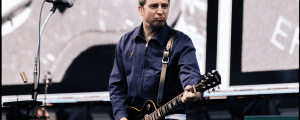
Photo by David Caudery/Total Guitar Magazine/Future via Getty Images
More Gear
-
Photo via Getty Images
![The Best Acoustic Guitars [2026, All Budgets]](https://americansongwriter.com/wp-content/uploads/sites/7/2024/03/best-acoustic-guitars-2026.png?w=300)