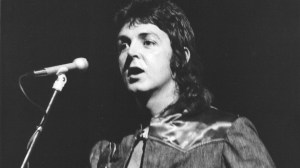
Glyn Johns initially made his mark in the music industry as one of the most in-demand engineers on the rock scene. He eventually segued to the production side of things. And he kept his hot streak rolling in that role.
The following four albums are among the most decorated of their time. And they all bear Johns’ production imprint.
Videos by American Songwriter
‘Who’s Next’ by The Who
Johns worked on many of The Who’s most important albums. Just getting along with that mercurial quartet for so long should earn him some praise for his interpersonal skills. On top of that, he helped wrangle the ambitions of Pete Townshend’s songwriting into music that was potent and widely accessible. Listed as associate producer on Who’s Next, Johns assisted the band in taking some of their more forward-thinking ideas, such as copious use of sequencers, and using them to complement their inherent rock power. It’s hard to imagine the album, essentially a trove of Townshend’s leftovers from the Lifehouse project, sounding so coherent without Johns’ influence.
‘A Nod Is As Good As A Wink …To A Blind Horse’ by Faces
Whereas The Who were a sleek rock machine in 1971, the year that Who’s Next arrived, Faces ambled into that year with a much different approach. Their ramshackle blues rock always seemed right on the edge of dissolving into chaos. On their first two albums, the band traded moments of glory with a bit of aimlessness. But A Nod Is As Good As A Wink …To A Blind Horse found them putting it all together. Considering that this bunch didn’t always have the best focus when making records, Johns clearly acted as a steadying presence in the studio. The end result is an album that doesn’t miss, whether getting raucous (“Stay With Me”) or sentimental (“Debris”).
‘Eagles’ by Eagles
Johns’ relationship with Eagles eventually deteriorated, despite the success he helped them earn right off the bat. He felt that the band was at its best in acoustic, country-folk mode, which is where he steered them on their first 2 ½ albums. The half-album comes from the fact that the band fired him halfway through On The Border in 1974 because they wanted to rock more. But the self-titled debut album preceded that drama. Johns played up the band’s harmonious strengths on classics like “Take It Easy” and “Peaceful Easy Feeling”. And despite their later objections about Johns, “Witchy Woman” certainly offers a slick, R&B-infused rock sound that showed Eagles’ versatility.
‘Slowhand’ by Eric Clapton
Here was a case of an artist purposely seeking out Johns, and the pairing working out swimmingly. Eric Clapton fully realized that he didn’t always maximize the potential of his music in the studio. He rightly understood that Johns could help him do just that. Sure enough, Johns managed to get Clapton and company to bear down in the studio and make a record that modernized his blues-rock sound to appeal to the masses. Clapton still delivers plenty of laid-back soul on “Lay Down Sally”, but the production doesn’t allow too much unnecessary noodling. On top of that, Johns brought out the rocker in Clapton on “C*caine” like few before had managed.
(Photo by Michael Ochs Archives/Getty Images)
More The List
-

Avril Lavigne (Photo by Jeff Kravitz/FilmMagic) -

British-born Australian Pop singer Olivia Newton-John (1948 – 2022) performs onstage at Forest Hills Stadium, Queens, New York, New York, August 13, 1982. (Photo by Gary Gershoff/Getty Images) -
Postcard '900. The Beatles. (Photo by Fireshot/Universal Images Group via Getty Images) -
NASHVILLE, TN – MAY 20: Singer John Anderson performs at SiriusXMs Music City Theatre on May 20, 2015 in Nashville, Tennessee. (Photo by Terry Wyatt/Getty Images) -
Photo by Michael Ochs Archives/Getty Images -
MERILVILLE, IN. – MAY 25: Iron Maiden at the Holiday Star Theater on May 25, 1982 in Merilville, Indiana. (Photo by Paul Natkin/WireImage) -
LONDON, ENGLAND – JUNE 06: Roger Waters performs on stage at The O2 Arena during the 'This is Not A Drill' tour, on June 06, 2023 in London, England. (Photo by Jim Dyson/Getty Images)