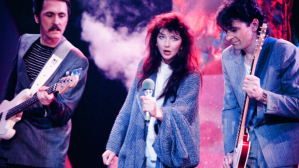
Here’s wishing a Happy Birthday to Topper Headon, the longtime drummer of The Clash, who turned 70 on May 30. Headon was simply one of the most dynamic beat-keepers to emerge from the British punk scene.
Born Nicholas Bowen Headon, he got his nickname Topper from Clash bassist Paul Simonon, who thought he resembled the character Mickey the Monkey from the popular British comic The Topper.
Videos by American Songwriter
Headon joined The Clash in May 1977, replacing founding drummer Terry Chimes. The first full Clash album Topper played on was the band’s second studio effort, Give ’Em Enough Rope (1978). He also appeared on several tracks included on the U.S. version of the band’s self-titled 1977 debut album, which wasn’t issued in the States until 1979.
Headon went on to play on The Clash’s next three albums, all of them classics—London Calling (1979), Sandinista (1980), and Combat Rock (1982). Topper struggled with heroin addiction, which led to him being fired from The Clash days before Combat Rock was released.
After his departure from The Clash, Headon released a solo album in 1986 called Waking Up. He was inducted into the Rock & Roll Hall of Fame as a member of The Clash in 2003.
While frontman Joe Strummer and lead guitarist/singer Mick Jones were the principal songwriters in The Clash, Headon co-wrote a number of the band’s noteworthy tunes. In honor of his 70th birthday, here are four great Clash songs co-written by Topper:
“The Magnificent Seven” (1980)
Sandinista was a triple-album set that marked the first time that The Clash credited most of the songs to the entire band, rather than just Strummer and Jones. The lead track, “The Magnificent Seven,” was co-written by Headon, Strummer, Jones and two members of Ian Dury and the Blockheads—bassist Norman Watt-Roy and keyboardist Mick Gallagher.
The funky tune was built around a bass loop played by Watt-Roy. It was inspired by such early hip-hop acts as The Sugarhill Gang and Grandmaster Flash & the Furious Five.
“The Magnificent Seven” became a Top-40 hit in the U.K. Although the song didn’t chart in the U.S., it became popular on college and underground radio.
“This Is Radio Clash” (1981)
“This Is Radio Clash” was another funk-infused song heavily influenced by early rap and hip-hop. Co-written by The Clash’s four members, it was released as a non-album single in November 1981.
The song features Strummer singing lyrics that reflect The Clash’s anti-authoritarian, anti-war beliefs.
The tune reached No. 17 on the Billboard Club Play Singles chart and No. 45 on the Billboard Mainstream Rock tally.
“Rock the Casbah” (1982)
“Rock the Casbah” was The Clash’s biggest U.S. hit, peaking at No. 8 on the Billboard Hot 100. In an unusual occurrence, Headon composed all of the music to the song, which appeared on the Combat Rock album.
The track came together while Topper was tinkering in the studio alone, without his bandmates. He came up with the song’s signature piano part, and also played drums and bass, so the music was nearly finished before the rest of the band worked on it.
Headon also had written lyrics for the tune, apparently a sexual ode to his girlfriend, but Strummer discarded them. Joe came up with song’s humorous Middle East-themed lyrics, partly about a sheikh whose efforts ban Western music are defied by some of his followers.
The popularity of “Rock the Casbah” was bolstered by a music video that got heavy airplay on MTV. Headon didn’t appear in the video, as he’d already been fired by The Clash when the promo was filmed.
“Should I Stay or Should I Go?” (1982)
“Should I Stay or Should I Go” also was from Combat Rock, and was co-written by The Clash’s four members. The infectious pop-rock tune, sung by Jones, became one of the band’s most popular and enduring songs.
The single initially peaked at No. 17 in the U.K. and No. 45 on the Hot 100.
In 1988, after it was used in a Levi’s commercial, “Should I Stay or Should I Go” was re-released in the U.K. and became The Clash’s only single to reach No. 1 in the band’s home country.
(Photo by Virginia Turbett/Redferns)
More The List
-
American country singer Bill Anderson on stage, USA, circa 1970-1980. (Photo by David Redfern/Redferns/Getty Images) -
UNSPECIFIED – JANUARY 01: Photo of Phil COLLINS (Photo by Ian Dickson/Redferns) -

UNITED KINGDOM – NOVEMBER 16: WEMBLEY ARENA Photo of RADIOHEAD and Thom YORKE, Thom Yorke performing live onstage (Photo by Patrick Ford/Redferns) -
Photo by Michael Putland/Getty Images -
NETHERLANDS – JANUARY 01: NETHERLANDS Photo of Liam GALLAGHER and Noel GALLAGHER and OASIS, L-R:Tony McCarroll, Paul 'Bonehead' Arthurs, Noel Gallagher, Liam Gallagher, Paul 'Guigsy' McGuigan – posed, group shot (Photo by Michel Linssen/Redferns) NETHERLANDS – JANUARY 01: NETHERLANDS Photo of Liam GALLAGHER and Noel GALLAGHER and OASIS, L-R:Tony McCarroll, Paul 'Bonehead' Arthurs, Noel Gallagher, Liam Gallagher, Paul 'Guigsy' McGuigan – posed, group shot (Photo by Michel Linssen/Redferns) -
LOS ANGELES – JUNE 12: Rock band Radiohead (Thom Yorke 2nd from left) poses for a portrait at Capitol Records during the release of their album OK Computer in Los Angeles, California on June 12, 1997. (Photo by Jim Steinfeldt/Michael Ochs Archives/Getty Images) -
American Country musician Vince Gill plays electric guitar as he performs onstage at the Beacon Theatre, New York, New York, May 15, 1991. (Photo by Gary Gershoff/Getty Images)