When you buy through our links, we may earn an affiliate commission.
Selecting the best acoustic guitar for your needs is a notoriously personal affair. First-hand anecdotes across the web speak of "bonding," not just with a particular model, but with a specific instrument. Many experienced players believe that you must spend time with a variety of individual instruments from the same product line to know which guitar is truly destined to be yours.
Do I personally believe this? Yes, and no. Not everyone has the freedom to play five Martin D-28s back to back, nor the ear to pick the "best" one out of a lineup. In my opinion, there is a fair amount of hokum that goes into the process of selecting an acoustic guitar—the mental gymnastics that come with making any hefty purchase. So I'm here to de-mystify the process a bit.
Yes, the top acoustic guitars on the market are handmade instruments, with the man-made quirks one would expect to come with their method of manufacture. But you can still select for trusted brands that are known for high levels of quality control, so there will be less variation between each individual instrument than you would find with a more cheaply-made model.
So while the "best" acoustic guitar is ultimately a subjective matter, there are still some rules of thumb you can take into account while picking. And at the end of this article, I'll take a deep dive into some of these factors. Materials used, build quality, bracing types, scale length, and optimal string gauge are just a few of the considerations to be made when selecting your "forever guitar." But more about that later.
I'm an acoustic guitarist and singer/songwriter with over 20 years of guitar-playing experience. I've compiled this list of the best-rated acoustic guitars on the market, mixed with my personal favorites that I've tested in recent months. I've tried my best to be objective, but it's admittedly difficult with a topic as personal as this one.
Without further ado, I present to you my guide to the best acoustic guitars of 2026. I hope you enjoy.
Quick Summary of the Best Acoustic Guitars
- Martin D-28 Standard Series (Best Overall)
- Yamaha FG800J (Best Acoustic Guitar Under $500)
- Fender CD-60S (Best Acoustic Guitar for Beginners)
- Gibson SJ-200 Original (Best Jumbo Acoustic Guitar)
- Fender Acoustasonic Telecaster (Best Acoustic Electric Guitar)
- Martin D-10E (Best Acoustic Guitar for Intermediate Players)
- Taylor GS Mini-e (Best Small-Bodied Acoustic Guitar)
- Gibson J-45 (Best Acoustic Guitar for Professionals)
- Takamine GY93E New Yorker (Best Acoustic Guitar for Fingerpicking)
- Martin D Jr-E (Best Travel Acoustic Guitar)
Best Acoustic Guitars
Best Overall
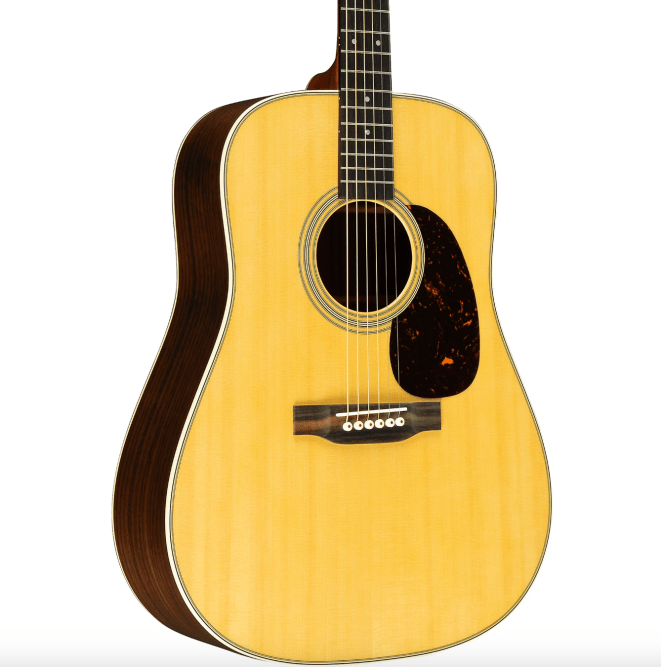

1. Best Overall – Martin D-28 Standard Series
SPECS
- Body Type: Dreadnought
- Top: Solid Sitka Spruce
- Back and Sides: Solid East Indian Rosewood
- Neck: Mahogany
- Fingerboard: Ebony
- Bracing: "Golden Era" Forward-Shifted Scalloped X
- Scale Length: 25.4
- Frets: 20 (14 playable)
- Finish: Gloss
The Martin D-28 acoustic guitar is really the all-time gold standard. From country legends like Hank Williams and Lester Flatt to contemporary rock songwriters like Dave Matthews and Noel Gallagher, the D-28 has been the acoustic guitar of choice for generations and is considered the all-time #1 by many.
This icon comes pretty much unchanged since the old days—and if you ask me, that's how it should be. In 2025, Martin refreshed their Standard Series guitars with vintage-inspired appointments that emphasize not only the timeless style of these iconic instruments, but also do a great deal to bring back the sonic profile of the legendary pre-war Dreadnoughts through their construction and materials.
The refreshed D-28 boasts the classic solid Sitka Spruce top and rosewood back and sides that this model is known for. Plus it's got an updated bracing pattern that's based on the vaunted "Pre-War" Martin Dreadnoughts. This “Golden-Era” forward-shifted, scalloped X-bracing relies on less contact between the braces and the top, allowing the top to resonate more freely for stronger projection, response, and sustain.
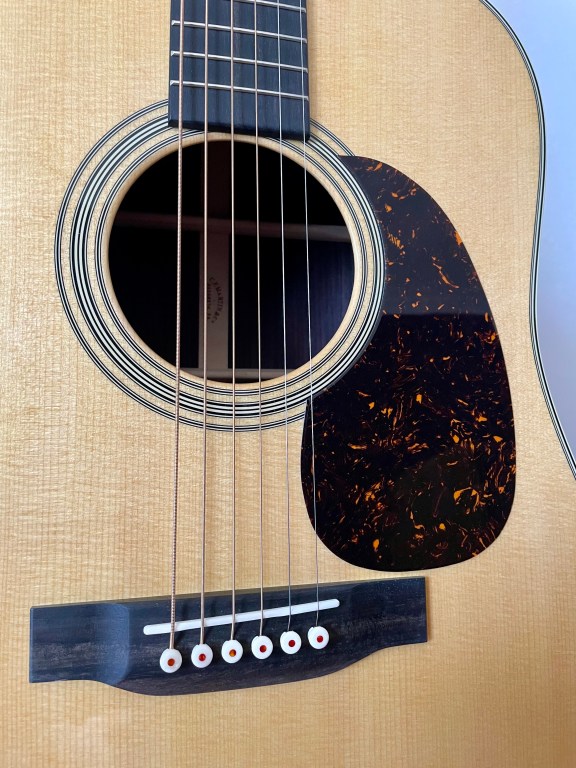
From our hands-on review: "The GE Modified Low Oval neck with High-Performance Taper is relatively slim, and feels more modern than what you might associate with a vintage guitar (although, in actuality, vintage Martins were made with a wide range of neck profiles over the years, including very slim ones). With slightly beveled fingerboard edges, it plays wonderfully, especially at the nut in first position—this thing feels made for bluegrass flatpicking and cowboy chords (and, truthfully, it is!)."
Slinging white-hot bluegrass licks shouldn't feel like swinging a nine-pound hammer. This guitar proves that Martin remains focused on what matters—building the best quality guitars and making history all the while.
You also might want to check out out the Martin HD-28, which features the iconic Pre-War style herringbone trim at the binding and gussied-up abalone inlays, if the Standard D-28 is a bit plain Jane for your taste.
Finally, the Martin D-18 is often compared and contrasted with the D-28. It could just as well be at the top of this list—it's a matter of personal preference. With mahogany back and sides in lieu of rosewood, you get a drier, crisper sound that some prefer—especially singers who are self-accompanying, and bluegrass pickers who want a twangier, more cutting tone. Read my full comparison article of the Martin D-28 vs. D-18 here.
- Avoid if: you don't need a large-bodied guitar. These are designed to cut through loud stringband arrangements and are set up to use .13 gauge strings. I'd suggest opting for a smaller-bodied guitar, like the 000-28, if you're solo fingerpicking at home. Learn more about body styles and string gauges in the buyer's guide below.
Best Under $500
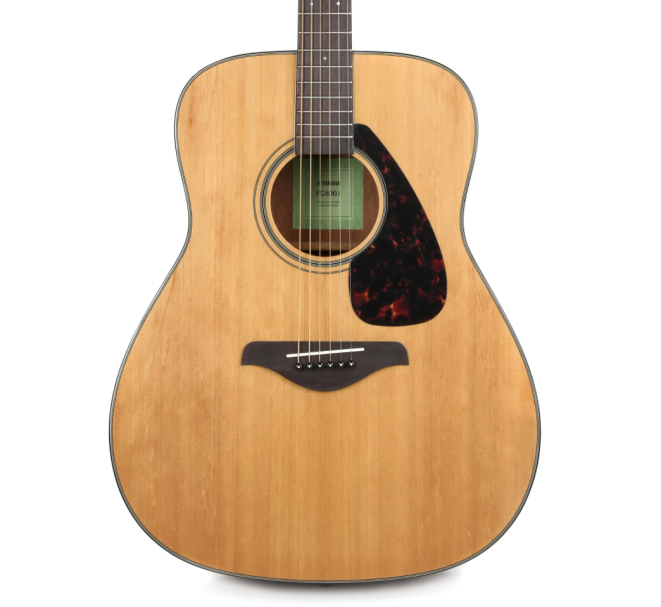
2. Best Acoustic Guitar Under $500 – Yamaha FG800J
SPECS
- Body Type: Dreadnought
- Top: Spruce
- Back and Sides: Nato/Okume
- Neck: Nato
- Fingerboard: Rosewood
- Bracing: Scalloped X
- Scale Length: 25.9/16"
- Frets: 20
- Finish: Gloss body/Matte neck
The Yamaha FG800J is, simply put, an incredible value for a budget acoustic guitar. Some might be put off by a guitar built by a company that also makes jet skis—but don't let that fool you. Yamaha makes a quality instrument, and the FG800J is no exception.
Let's start with the solid spruce top. Most acoustic guitars at this price point are going to be built with a laminate top. These will provide solidity but lack the resonance and punch of a solid top, which the FG800J brings in spades.
This line also features a scalloped bracing construction as of 2016. This is another feature that will not be commonly found in most acoustic guitars under $500! The exotic-sounding tonewoods Nato and Okume are also known as "Eastern Mahogany," so there won't be any surprises there.
Real heads know the Japanese-made "Nippon Gakki" Yamaha guitars have been an affordable holy grail in the acoustic guitar world for generations, and not much has changed there. In fact, Yamaha only continues to improve their build quality over the years—and their acoustic guitars are a great bang for your buck across the board.
Avoid if: You can afford to splurge a bit more. Let's be real—these are great guitars for the money, but if you're shopping for your forever guitar, you may want to shell out. The Yamaha LL6 ARE, for example, is a solid upgrade from the FG800J.
Best for Beginners
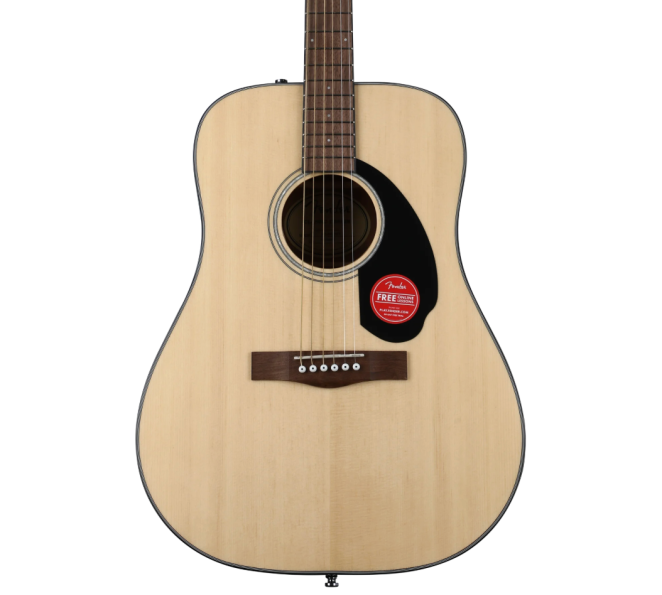
3. Best Acoustic Guitar for Beginners – Fender CD-60S
SPECS
- Body Type: Dreadnought
- Top: Laminated Spruce
- Back and Sides: Laminated Nato
- Neck: Nato
- Fingerboard: Walnut
- Scale Length: 25.3"
- Frets: 20
- Finish: Gloss
Our pick for one of the best beginner acoustic guitars is the Fender CD-60S. The "CD" in CD-60S stands for "classic design," which this guitar has in spades. From its body shape and scalloped bracing to its quality tonewoods, this guitar brings everything you want in a dreadnought guitar at a great price that's perfect for beginners.
Solid tonewoods and quality Fender hardware set this guitar apart from other budget models. The spruce top of the CD-60S ensures that this guitar delivers a classic, bright acoustic tone. The action is great, straight out of the box, and ready for beginners to start working out their first chords.
When it comes to budget guitars, today's market offers much higher quality than you'd expect. The Fender CD-60S is no exception. I actually bought one of these at the local music shop where my in-laws live so I would have something to play when I visit. It sounds and plays great—especially for its price point.
With its surprising sound quality and build construction, I consider the CD-60S to be one of the best acoustic guitar deals available today. Especially when you bundle as a starter pack for just $30 more (includes a strap, an extra pack of strings, a gig bag, picks, and a 3-month Fender Play subscription—highly recommended for beginners).
- Avoid if: You're buying for a small child. You might want to opt for something smaller than a full-size dreadnought, like the Yamaha JR1 3/4-size Dreadnought.
Best Jumbo Acoustic
4. Best Jumbo Acoustic Guitar – Gibson SJ-200 Original
SPECS
- Body Type: Jumbo
- Top: Solid Sitka Spruce
- Back and Sides: Flamed Maple
- Neck: 2-piece Maple
- Fingerboard: Rosewood
- Scale Length: 25.5"
- Frets: 20
- Finish: Gloss Nitrocellulose Lacquer
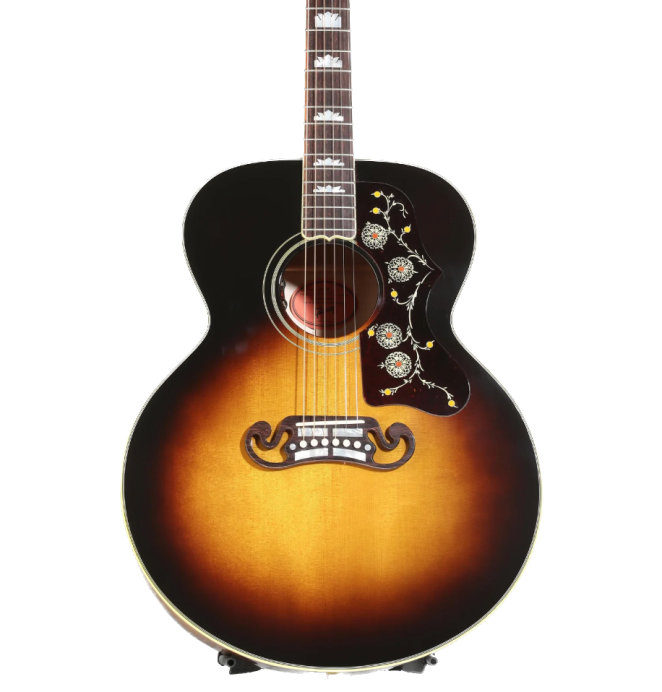
Remember when we said acoustic guitars aren't cheap? This is what we were talking about: "The King of the Flattops." The Gibson SJ-200 Original is the premium, top-of-the-line acoustic guitar, with no punches pulled, no expense spared down to the last detail.
The Super Jumbo body shape debuted in 1937 when Gibson used an archtop body mold to build a massive flattop acoustic for cowboy singer Ray Whitley, who wanted a big, flashy guitar befitting his Hollywood cowboy image. In the years since, it has come to be favored by such artists as Elvis Presley, Emmylou Harris, and Tom Petty. Read my blog post to learn more about the history of the SJ-200.
Constructed with a solid Sitka spruce top and rosewood back and sides, with a cavernous sound cavity to boot, this guitar was designed to project. Add to that a set of LR Baggs pickups and electronics, and you're all set to front a raucous country or rock band.
As I said, Gibson spares no expense here: you get top-line hardware like Gotoh Keystone tuners, as well as real bone saddles, mother-of-pearl crown inlays, and fancy carved embellishments and inlays throughout (including the iconic "moustache" bridge).
- Avoid if: you're not made of money. Kidding aside, if you want the SJ-200 look, feel, and sound, but are balking at the price, check out the much more affordable Epiphone version.
- If you prefer lighter-built acoustics, this one is not for you. Its all-over gloss finish and other bells and whistles can be a bit much (unless you happen to be Elvis Presley). Take a look at the J-45 if you want a premium Gibson acoustic that's a bit lighter on its feet.
Best Acoustic Electric
5. Best Acoustic Electric Guitar – Fender Acoustasonic Telecaster
SPECS
- Body Type: Semi-hollowbody acoustic-electric/Acoustasonic Telecaster
- Top: Lutz Spruce
- Back and Sides: Mahogany
- Neck: Mahogany
- Fingerboard: Ebony
- Scale Length: 25.5"
- Frets: 22
- Finish: Matte
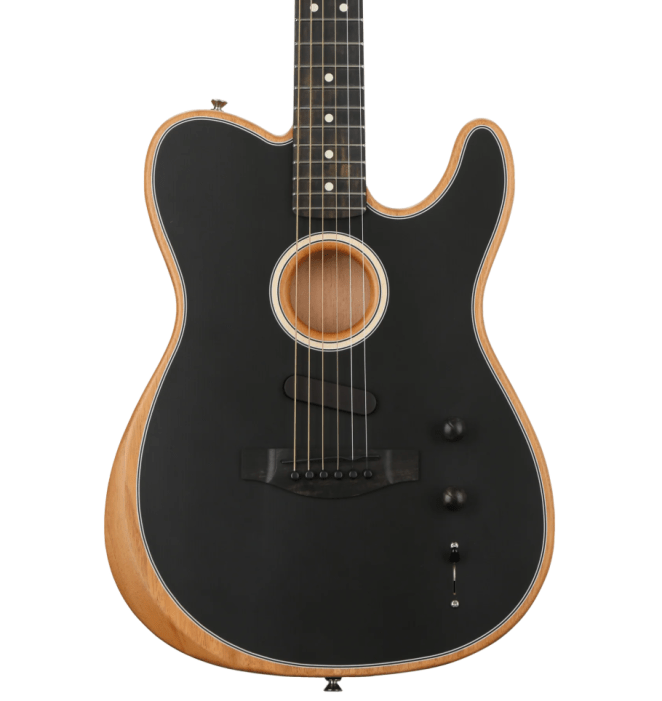
Many of the guitars on this list are acoustic-electrics, so I thought I would highlight something really different for this slot. The Fender Acoustasonic Telecaster combines the best qualities of a great acoustic with those of a classic Fender Telecaster to create a truly unique and versatile instrument with a ton of really useful and interesting features.
This guitar aims to supply everything you'd want in both an acoustic and electric guitar, in a really distinctive way. It's got 10 distinct voices, accessible via a five-way pickup selector, and a Telecaster bridge pickup—plus a Fishman Matrix under-saddle piezo acoustic guitar pickup. An ebony-capped "Deep-C" profile neck and solid Spruce top complete the picture.
If you're looking for an acoustic-electric guitar that combines the versatility of a modern electric instrument with the pristine tones of an acoustic, you've found it with the Acoustasonic Telecaster. Be sure to check out the rest of the Acoustasonic series as well! There are models based on other classic Fender designs, as well as more affordable options than the USA-made Tele.
- Avoid if: You're looking for something more traditional. For another acoustic-electric guitar in the same price range, with similar versatility and quality but a more classic look, check out the Taylor 114CE.
Best For Intermediates
6. Best Acoustic Guitar for Intermediate Players – Martin D-10E
- Body Type: Dreadnought
- Top: Solid Spruce
- Back and Sides: Solid Sapele
- Neck: Select Hardwood
- Fingerboard: Ebony w/ diamond inlay
- Scale Length: 25.4"
- Frets: 20
- Finish: Satin
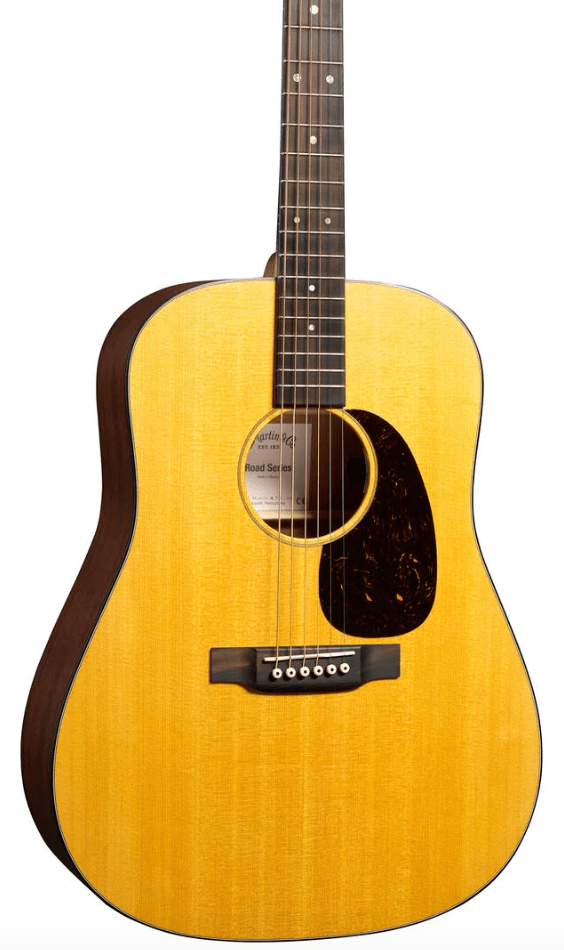
Martin refreshed their Road Series in 2025, introducing a number of really exciting instruments for intermediate players. The D-10E is a D-style guitar with a lot of premium appointments, but it's available at well below the price point of the Standard Series offerings. That makes it the perfect pick for an intermediate guitarist looking to get a taste of Martin without having to sacrifice ~10 car payments.
The D-10E's solid sapele back and sides replace the customary mahogany or rosewood. This tonewood, which is commonly used in budget guitars, is often compared sonically to mahogany. A solid spruce top and scalloped X-bracing offer the projection and resonance you would expect from a much pricier Martin.
"Retro" aesthetic touches like the diamond inlays and open-gear Grover tuners imbue the vibe of the classic Dreads that are the holy grail for acoustic players like me. Pair that with a modern Performing Artist neck profile and Martin E-1 electronics, and you've got the best of the past and the present.
Any Martin enthusiast would do well to own one of these for touring, travel, and the like. But I think it's an especially good choice for intermediate players as a stepping stone from a budget guitar to something a bit more weighty. I would challenge any player to jam a bit on one of these and tell me they are not playing a D-18!
- Avoid if: You want all this, but fear a Dreadnought is not for you? Opt for the OM-10E from the same series for similar appointments in a smaller body size.
Best Small Bodied Acoustic
7. Best Small-Bodied Acoustic Guitar – Taylor GS Mini-e
SPECS
- Body Type: GS Mini (scaled-down Grand Symphony)
- Top: Tropical Mahogany
- Back and Sides: Layered Sapele
- Neck: Maple
- Fingerboard: Ebony
- Scale Length: 23.5"
- Frets: 20
- Finish: Matte
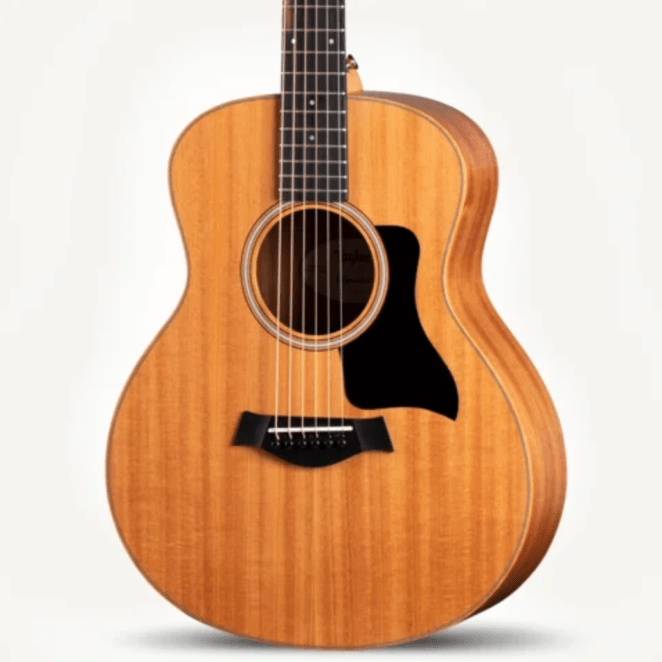
Taylor Guitars are known as one of the top acoustic guitar manufacturers on the market today, and the GS Mini lives up to that reputation and then some. It's incredible what they've managed to pack into what's basically a modern update on the parlor guitar.
For a smaller-bodied acoustic, the GS Mini-e packs a punch, especially when using its built-in ES-B electronics system. Unplugged, it's a great little picker for home use and travel. Its oversized soundhole and X-braced construction deliver an outsized sound for such a small guitar.
This guitar's use of premium tonewoods (Tropical Mahogany top, layered sapele back and sides) paired with its Grand Symphony body shape ensures an unbelievably rich tone for a small-bodied guitar. At a total length of 36 inches, it's portable, packable, and playable, pretty much anywhere you want to go.
The specs I've listed here are for the base mahogany model, but the GS Mini comes in a variety of tonewoods, electronic configurations, and finishes, meaning there is a GS Mini for just about everyone.
This guitar is a testament to the value of solid wood and a good pickup and preamp system when it comes to acoustic-electric instruments. For a mid-range acoustic that's great for traveling, home use, and gigging, you can't do much better than the Taylor GS Mini-e.
- Avoid if: I've sought to be impartial in my list, but some people find that Taylors tend to sound too bright for their taste—no shade. Martin's revamped Junior series has similar offerings, like the D Jr. E, that tested very well for us.
Best Professional Acoustic
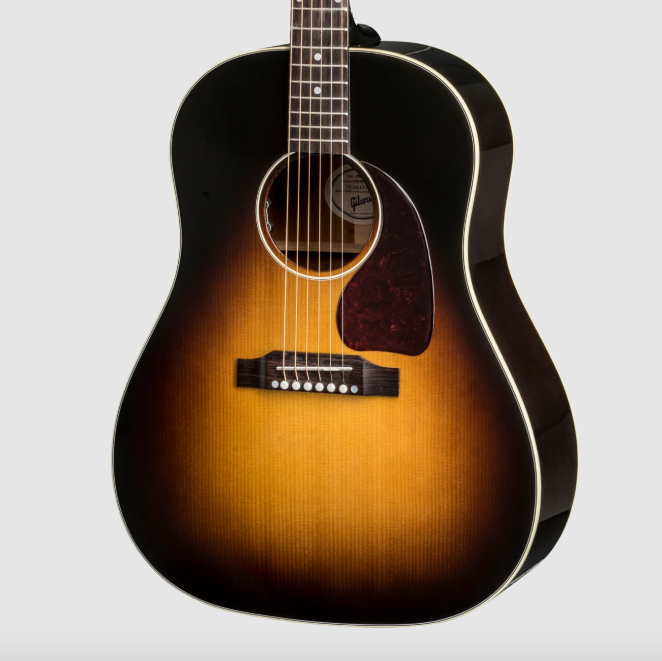
8. Best Acoustic Guitar for Professionals – Gibson J-45 Standard
SPECS
- Body Type: Slope-shouldered Dreadnought
- Top: Sitka spruce
- Back and Sides: Mahogany back and sides
- Neck: Mahogany
- Fingerboard: Rosewood
- Scale Length: 24.75"
- Frets: 20
- Finish: Satin nitrocellulose
The Gibson J-45 is another premium offering from the master craftspeople at Gibson. But in contrast to the SJ-200, this slope-shouldered Dreadnought represents a no-frills approach to acoustic guitar design that has earned it the reputation of Gibson's "workhorse" guitar. (The "45" in its name is a nod to its MSRP at time of release: $45. Sob.)
An iconic instrument in its own right, the J-45 rivals Martin's D-28 for recognizability. Famously played by the likes of Bob Dylan and Margo Price, this simple spruce and mahogany flattop has been the guitar of choice for leagues of songwriters over the generations.
With a shorter scale (24.75") than a Martin dread, the J-45 has a unique sound and feel that is as iconic as its Sunburst finish. This scale length gives you a slightly slinkier feel. When paired with its narrower nut width (compared to a D-28) and a slim modern neck profile, today's J-45 is easy enough to play for beginners, while boasting hand-crafted quality that's worthy of professionals.
The mahogany back and sides give you a direct, dry tone that's midrange-focused, while the hand-scalloped X-bracing allows the spruce top to ring like a bell. Add to that the LR Baggs VTC electronics system, and you've got a guitar that's sure to stun onstage as well as at home.
Premium hardware—like the Grover Rotomatic Tuners, a satin nitrocellulose finish that will age like a true vintage guitar, and a Gibson hardshell case complete the package. If you're a Gibson nut looking for a professional acoustic guitar, you need to add this "horse" to your stable. Yee-haw.
- Avoid if: You're worried about your investment taking a beating on the road. You might want to look into alternatives, like this licensed J-45 made by Epiphone.
Best for Fingerstyle
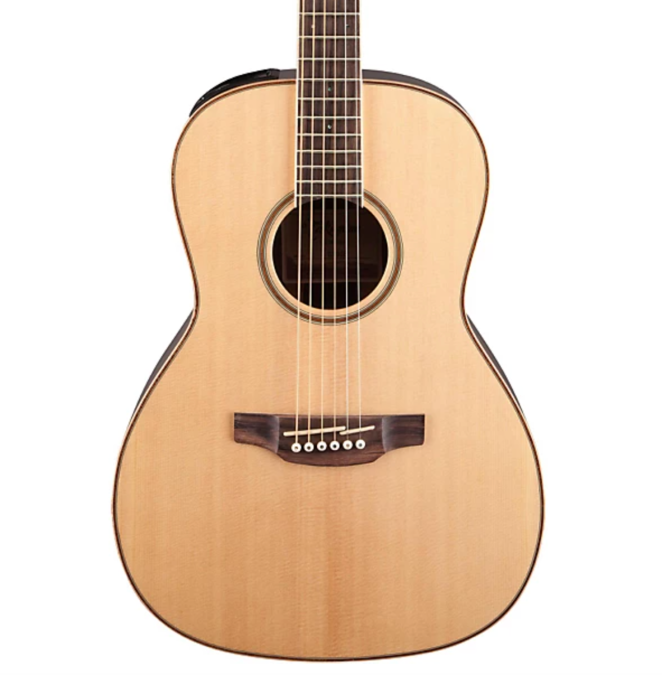
9. Best Acoustic Guitar for Fingerpicking – Takamine GY93E New Yorker
SPECS
- Body Type: New Yorker (parlor)
- Top: Solid Spruce
- Back and Sides: Black Walnut & Quilted Maple
- Neck: Mahogany
- Fingerboard: Rosewood
- Scale Length: 24.8"
- Frets: 21
- Finish: Satin
The Takamine GY93E New Yorker is a parlor-sized acoustic that delivers some great features in a small package. Beautiful, understated styling and premium appointments aside, this guitar boasts a great electronics system that makes it really useful for gigging fingerstyle players.
While I don't really believe in such a thing as a "best" guitar for fingerpicking per se, the GY93E offers some unique features that make this guitar especially suited to sensitive playing.
Premium tonewoods and scalloped X-bracing combine to make a resonant instrument that packs a significant punch for its size. Channel that through its battery-powered TK-40D preamp (which features a gain knob, built-in tuner, and active shelving EQ with bass, middle, and treble sliders), and you have a great-sounding and versatile gigging folk guitar.
If you're a folk/fingerstyle player who needs to step it up for gigging, you can't go wrong with this impressive offering from Takamine. Its small size means portability and convenience, but it doesn't mean sacrificing big sound and versatility thanks to this guitar's great design and electronics. Plus, it doesn't hurt that this baby clocks in at under $1000.
- Avoid if: You don't want onboard electronics. Luckily, Takamine makes a version of this guitar without them.
Best Travel Acoustic
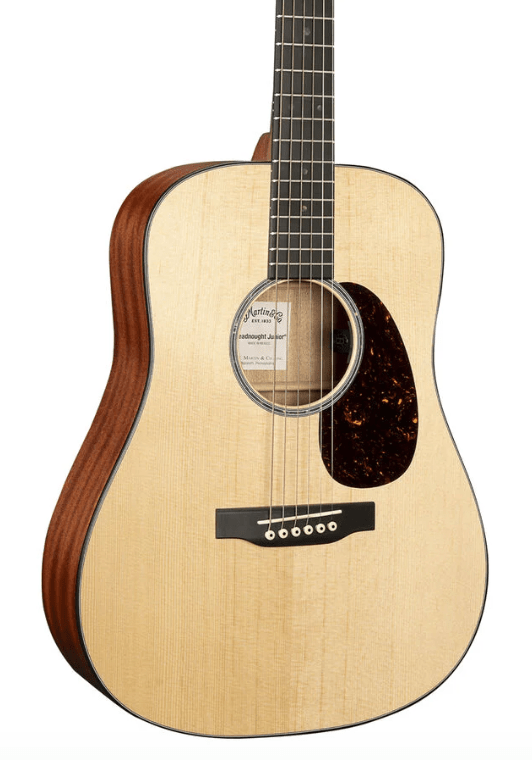
10. Best Acoustic Guitar for Travel – Martin D Jr-E
SPECS
- Body Type: Dreadnought Junior
- Top: Spruce
- Back and Sides: Sapele
- Neck: Select hardwood
- Fingerboard: Richlite
- Scale Length: 24.9"
- Frets: 20
- Finish: Satin
Rounding out our list is the Martin D Jr-E. The D Jr-E is a slightly downsized Dreadnought that manages to be small enough for travel while, paradoxically, still maintaining a full scale length. Martin's recently refreshed Jr Series has some great offerings, but this one's my favorite because I'm a sucker for their classic 14-fret dreadnoughts.
I had the good fortune to try out the D Jr-E in the Streetlegend Burst trim. From my review:
"A major selling point of the Junior Series is that they are compact and lightweight, perfect for travel, gigging, or just slinging around the house. With the Junior Dreadnought, you get the benefit of this compact size, but with the iconic aesthetics of a Dreadnought.
You get 14 playable frets, on a super-slim satin-finish Performing Artist neck. This neck is just crazy playable, with beveled frets for enhanced ergonomics (meaning: feels good). It’ll fit in anyone’s hand, even people with smaller hands.
Strummed first position and barre chords are boomy and resonant—none of that tinny, thin sound I typically associate with smaller budget-range guitars. And flatpicked licks, forget about it. That’s what these guitars are made for! Honestly, the sound is comparable to a full-size Dreadnought. Big points awarded to Martin’s engineering here."
Plus, the D Jr-E is outfitted with Martin's E-1 electronics system, which includes a volume, tone control, and tuner, all just inside the guitar's soundhole. This makes the guitar great for gigging as well. It's just a ton of quality, versatility, and portability for under $1000. A great travel guitar for Martin enthusiasts like me who don't want to take their beloved D-28 to the beach.
- Avoid if: You don't need electronics in your travel guitar. A Taylor GS Mini might be a better choice for you.
Best Acoustic Guitars: Buyer's Guide
Shopping for an acoustic guitar can seem complicated, but it doesn't have to be. These days, even though so much of our shopping is done on the Internet, it can seem counterintuitive to seek out something as personal as your dream guitar online.
Fortunately, I've included this handy buyer's guide to help answer some of your burning questions so you can narrow down your search and get started finding the best acoustic guitar for you.
Body Type and Size
Acoustic guitar bodies come in all shapes and sizes. These include dreadnought, concert, jumbo, and many, many more. I've included guitars of a variety of different body styles and shapes on this list, so you should have a good sense of what each of these is like if you've read up to this point.
Each body type has its own tonal characteristics and feel. Ultimately, you're going to want to choose a size and shape that suits your own personal playing style, as well as your own body and hand size.
For example, if you're a young beginner, or just a person with smaller hands, you might want to consider a smaller guitar like a parlor or 000. Beginners may also want a guitar with a comfortable neck profile, lower action (string height), and one that's optimized for lighter-gauge strings for ease of playability.
The wrong-sized guitar can even present painful ergonomic issues, so choose carefully. Smaller players might have trouble reaching their arm around a dreadnought or jumbo, which can lead to shoulder, elbow, and wrist problems (if you practice enough). Plus, bigger guitars are often built to respond better to heavier-gauged strings. Stronger, more experienced players will generally have a much easier time with these.
Finally, different body styles are also suited for different playing techniques and genres. Players who favor fingerstyle tend to lean towards smaller-bodied guitars, while someone strumming at the front of a band would do better with the massive sound of a dreadnought or jumbo. But with a wide range of models available with onboard electronics, this isn't as definitive a factor as it was in the past.
Tonewoods
Generally, a guitar's tone will be determined by some combination of the body style/size, tonewoods used, bracing and other construction factors, and, if it's an acoustic-electric, any built-in onboard electronics it might have, like a pickup and preamp system.
I already described above how the body style and size might influence a guitar's sound. So, a quick recap: generally, a smaller body is going to have a lighter and brighter sound, while a larger body will have a boomier and louder sound with more mid-range and bass response.
The tonewoods used in the construction of an acoustic guitar will also significantly impact its sound. Common tonewoods include spruce (top), cedar (top), mahogany (back and sides), and rosewood (back and sides, fretboard).
The type of wood used for a guitar's back and sides is the most commonly cited source of tonal discrepancy. Generally, mahogany vs. rosewood is the topic of debate. Mahogany is thought by most players to sound more "dry," direct, or "woody" in nature. Rosewood, meanwhile, has a more "piano-like," chiming, or sparkling resonant tone. Which of these you like better will come down to personal preference. I suggest listening to sound snippets online to get a better idea of which you prefer.
More affordable budget guitars are often built with wood laminates or composites rather than solid woods, but that isn't always a bad thing. For example, Martin has boasted that their HPL is more durable and less sensitive to humidity than solid woods.
Bracing
There are a ton of different ways to brace an acoustic guitar. Bracing refers to parts of the internal construction of a guitar, which generally comprises slats or strips of wood configured in various ways to strengthen the guitar and improve its resonance.
Some common types of bracing include:
- X-bracing
- Scalloped X-bracing
- Forward-shifted X-bracing
- Ladder bracing
- V-class bracing
- Fan bracing
Typically, higher-quality acoustic guitars feature some variation of X-bracing, which was pioneered by Martin. The best acoustic guitars today, like the Standard Series D-28, tend to use scalloped X-bracing, which has bits of wood "scooped" or carved out of the braces to allow the top to vibrate more freely for enhanced resonance and projection.
Electronics
If you intend to plug in, it's very important that you consider how much control you need and what sound you want. Some guitars have built-in systems with volume and tone controls, while others have but a simple pickup and input jack. And many acoustic guitars have no electronics at all.
All that craftsmanship and tonewood goes out the window if you have crummy pickups. L.R. Baggs and Fishman are two brands that are known for making some of the best acoustic guitar pickups, and are commonly found on higher-quality guitars with built-in electronics.
Build Quality and Craftsmanship
Classical guitars were originally conceived as finely tuned, hand-crafted instruments comparable to classical stringed instruments like the violin or cello. However, in the day and age of mass production and cheap labor, this isn't always the case.
When you receive your new guitar, make sure you pay attention to such details as the consistency of the finish, checking for any chips/cracks, as well as testing the action and intonation. This can be done by playing notes all the way up the neck.
Many guitars play perfectly straight out of the box, but this isn't always the case. It's not the end of the world if you have to take your new guitar in for a setup. Just take it to your trusted local luthier or guitar shop, and they should be able to get your new guitar set up to your liking.
Budget/Brand Reputation
As with most music gear, there are a few storied brands that are highly regarded and widely trusted as makers of fine instruments. These include Martin, Gibson, Taylor, and a few others.
But that's not the whole story—there are lots of manufacturers that create quality instruments, often at a more affordable price point than some of the better-known brands. The key to finding one of these is simply to shop around and by checking out lists like this one.
You can find out which brands have a good reputation, even if they are lesser-known, by reading reviews online. You can also try to test out some guitars at your local guitar shop. Just remember that your preference is what's most important, and brand name isn't everything.
As with anything, you should determine your budget range before starting your search. Acoustic guitars vary widely in price, and having a budget in mind will help narrow down your options.
Best Acoustic Guitars Frequently Asked Questions (FAQs)
How do I care for my acoustic guitar?
As with any guitar, a good place to start is changing the strings every once in a while.
Depending on how much and how often you play, you might want to consider changing your strings once every few months. You'll know when your strings are "dead" by the way they sound. Dead strings lack the brightness and vibrance of new strings and sound more muted. And make sure to use the recommended string gauge for your guitar!
You may as well go ahead and clean your acoustic guitar's body, neck, and fretboard while the strings are off. This can be done with a soft cloth and some lemon oil or a specially formulated guitar cleaning solution. Just make sure your guitar's finish is compatible with your chosen cleaning product first.
Acoustic guitars, especially those made of solid wood, are susceptible to changes in humidity. It's recommended to keep the humidity levels between 40-60% to maintain the guitar's stability and prevent issues like cracking or warping.
This may or may not be a problem depending on the humidity of your guitar's environment, but it isn't a bad idea to keep your guitar in a case. If you're really concerned about protecting your investment, there are special guitar humidifiers cheaply available as well.
Should I buy a guitar with electronics (pickup system)?
If you plan to gig with your acoustic guitar, especially with a full band, you should definitely consider getting one with built-in electronics. Trust us, it will make your life (and the sound engineer's) so much easier.
There are tons of different types of electronic systems available, and they commonly come built right into the guitar out of the factory. For example, the Gibson SJ-200 Deluxe comes equipped with an LR Baggs VTC system.
A built-in electronics system is better than adding an after-market pickup in that it allows you to amplify the guitar's sound as well as adjust volume and tone controls yourself, and you don't have to make any permanent alterations to your instrument.
How important is the brand when buying an acoustic guitar?
While more expensive guitars often offer higher quality and better craftsmanship, there are affordable guitars that can still provide a satisfactory playing experience for beginners and casual players.
This list features acoustic guitars at various price points, including budget-friendly options like the Yamaha FG800 or the Fender CD-60.
Ultimately, you should just pick one out that you like, in a price range you're comfortable with. Brand name is more or less important to different players—this one is up to you.
Best Acoustic Guitars: Verdict
We've included something on this list for everyone. From budget-friendly picks like the Yamaha FG800J to the extremely high-end Gibson SJ-200 Deluxe, we've done our best to bring you the best acoustic guitars available today.
The single best acoustic guitar, while not an easy call to make, had to go to the Martin D-28. I just think this all-time classic offers everything you'd want in an acoustic guitar—the platonic ideal, if you will.
But it doesn't end there. Go back and give our list another look! There's sure to be a great acoustic guitar in your price range that you're gonna love. Thanks for reading.