Brian Cullman has spent a lifetime around music, not just covering it, but being part of the world it comes from. His perspective feels earned. It comes from being in the room, paying attention, and sticking around long enough to see how things actually unfold.
His new book, How To Prepare For The Past: Travels In Music And Time, reflects that way of seeing. It moves through a series of lived moments with artists like Nick Drake, Miles Davis, Sandy Denny, and Chuck Berry, but it’s not trying to document history from a distance. It’s closer than that. The focus is on the details that stay with you. A room, a conversation, the way a song lands in real time. As you read, you start to feel how music moved through those spaces and how it connected people without needing to be explained.
Videos by American Songwriter
Our American Songwriter membership asked Brian about how he approached writing it, how being around certain artists changed the way he hears their music, and how some songs still bring him right back to a specific place.
Dean Fields: You said, “When people asked me my favorite song, I would say the radio… How can I choose my favorite part of the rain?” That line really stuck with me. There’s something in it about how big the experience of music can be. When you were writing the book, were you trying to hold onto all of that, or did it become more about choosing moments and shaping them?
Brian Cullman: Whenever I tried to hold onto the full experience, it was just too big. I couldn’t carry it, much less make sense of it. But if I could focus on one moment, someone saying my name, the light coming through a window, the smell of Turkish coffee, a piano being tuned down the hall, if I could catch that, then the rest of it would come with it. Or as much of it as could fit on the page.
DF: The book really puts you in those rooms, with people like Nick Drake, Sandy Denny, Miles Davis. Was there a moment where being there changed the way you heard someone’s music?
BC: That’s always the hope, to make it feel like you’re there. I wanted to avoid nostalgia and actually recreate the experience, like it’s unfolding in real time. You have to convince the reader, but you also have to convince yourself. When it works, it feels like a gift. When it doesn’t, I leave it out.
Being around someone who’s really listening changes everything. I remember going to hear pianist Steve Kuhn with Mike Zwerin, who had played with Miles early on. Kuhn was playing in a restaurant where no one was really paying attention. But Zwerin was. We were standing at the bar, and even if Kuhn couldn’t see us, he could feel that someone in the room was locked in. His playing changed. The space between the notes shifted. The intensity came forward.
And being with Sandy Denny in her flat, watching her listen to songs, Bob Dylan demos, new Richard Thompson songs, that changed how I hear her voice forever. Now, when I hear her, I’m back in that room. The light, the air, everything.
DF: Music feels like the thread through the whole book. Are there songs that take you back to a specific place?
BC: In college, I had a turntable next to my bed that would just play records on repeat all night. I kept three there. Astral Weeks by Van Morrison, a Javanese gamelan record, and Ruth Laredo playing Scriabin.
The same thing would happen every night. I’d be half asleep, and my roommate Jay would come in drunk and pass out on the floor. After a few minutes, he’d look up.
“Scriabin?”
“Scriabin.”
“Horowitz?”
“Laredo.”
“Yeah, I knew that.”
And he’d go to bed. The record would keep playing.
Now whenever I hear Scriabin, I’m right back there. That room, that time, everything still in front of me.
DF: There’s a feeling in the book that a lot of this happened by accident. Looking back, how much of it was intentional?
BC: Not almost by accident. Completely by accident. I’ve never been great at making plans. I’ll head one way and end up somewhere else entirely. It usually works out.
DF: The title suggests looking back, but also something more active. After writing the book, do you understand your past differently? What does it mean to prepare for it?
BC: Are you kidding? The past is still happening. Here it comes.
Brian Cullman’s book, How To Prepare For The Past: Travels In Music And Time, is out now.
Become an American Songwriter member and get exclusive content, including access to the songwriters behind hit songs by Ed Sheeran, Bonnie Raitt, Morgan Wallen, Guns N’ Roses, and more. Plus exclusive content, events, giveaways, tips, and a community of songwriters and music lovers.
Photo via Brian Cullman
More Interviews
-
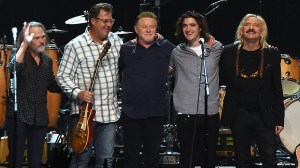
NASHVILLE, TN – OCTOBER 29: Eagles, Timothy B. Schmit, Vince Gill, Don Henley, Decon Frey and Joe Walsh perform during the Eagles in Concert at The Grand Ole Opry on October 29, 2017 in Nashville, Tennessee. (Photo by Rick Diamond/Getty Images) -

NASHVILLE, TENNESSEE – SEPTEMBER 12: Honoree Vince Gill attends CMT Giants: Vince Gill at The Fisher Center for the Performing Arts on September 12, 2022 in Nashville, Tennessee. (Photo by Jason Davis/Getty Images for CMT) -
Photo by Ingrid Fortenberry