
A lot of people pegged you as southern; in fact, everyone thought you were born on the bayou. How did you develop the sound that became identified with Creedence, the swamp pop, the accent you sing in? Was that intentional or was that just something that came out with the music?
No. It was quite intentional. But it was intentional in the precocious way that young people just know they’re doin’ the right thing. I had a life in music starting when I was 3 years old or so. Music was just in our house. I’ve already explained the Stephen Foster thing, but there were many other examples of music being around. And then as I began to adopt or glom onto things and go, “Yeah, I get that” — when I heard the Ventures’ “Walk Don’t Run” or I heard Duane Eddy and got such a clear vision of “yeah, that’s what I want to do,” or seein’ Elvis on TV and finding myself the next day in front of a mirror with a broom, mimicking Elvis’ stance and the whole thing — you were taking that as your own because you thought was cool. I was certainly being influenced by all this stuff that was going on that I thought was cool, and I did that until I got to be 19, 20, 21 even. By now I’ve had a couple of guys that I was in a band with, and certainly my brother. But things kept evolving in and out. I’d be with other musicians, and we were just covering — you know, we’d get a job at a bar somewhere and we’d be covering the songs on the radio ‘cause that was the cool thing to do. But I was trying to write music on my own and with my brother, Tom. Every once in a while we’d get to go make a record, or a recording at least. And sometimes, a recording would actually be a real record. Amazingly, at 14, because I had been playing some shows in my El Cerrito Boys Club, representing the boys club of my hometown, I met a rhythm ‘n’ blues artist named James Powell, who was at one of these things that we did. And he enlisted us to help him record some of his songs. So at 14, we recorded a song with James Powell called “Beverly Angel.” It was recorded in a real studio — the same studio, by the way, that 10 years later, I’d record my version of “Suzie-Q.” Anyway, we recorded this song with James Powell; that song was played on the radio. Our local rhythm ‘n’ blues station. I’m 14 years old and I’m playin’ bass as an overdub and guitar on this record that’s on the radio. That’s like, “What?” Unless you’re with Disney nowadays, how does that happen? It’s so long ago. I was just sort of going along and trying to do what’s right.
So you raised the question, how did this southern thing happen? The sound and all that really started, kind of, when I was in the Army. I was on active duty in 1967, marching around in 115-degree heat on a parade ground that was mile square, a huge asphalt thing. Marching around endlessly. ‘Cause they don’t know what to do with you while you’re at boot camp. They can’t just have you go eat somewhere and then fall sleep for three hours under a tree. They gotta keep you moving. So a lot of times, they were marching 5,000 guys, broken up into little platoons, just marching around endlessly. It’s silly. This was at the height of the Vietnam War, of course, so I would kind of go into a delusional state. You’re just marching along, blindly looking at the guy in front of you. I would have these delusions, one of which was, I would be trying to polish a spit-shine army boot, the toe. And I’d be shining it, but there’d be this one little fingerprint. I’d go to rub it, to make it shiny, and it would move, like animated art. It would move over to another part of the toe. It’s supposed to be shiny like a mirror. So I’d be walking along, hyperventilating, delusional from the heat, probably one step away from heat stroke because you’re in full battle gear with your boots and rifle and helmet and all that stuff. So I was doing that and I would go into kind of writing. And I started writing this narrative that was kind of about my childhood.
When I got home, off of active duty, and reconnected with my brother and the other two guys who became Creedence, that narrative I was writing out there became a song called “Porterville.” That was my first cool song that was kind of about something real that affected me, rather than just trying to write I love you, you love me, why you treat me so bad? All those kinds of songs that I’d been writing ‘cause that’s what was on the radio, trying to imitate that stuff. This was me. So That first recording and that first song, I can’t say it was great. It’s on the first Creedence album. But what it did was, that door was opened. I realized I had a really strong — I wasn’t calling it southern yet; I just called it rural — I had a really strong connection with the kind of thing that’s a narrative about your view of the world and your own life. It’s a little bit of a fantasy world, I must say. Kind of like Tennessee Williams as far as prose. I pictured things like Cat On A Hot Tin Roof.
After that song, after that writing, I moved to an apartment and I began to stay up and try to write songs. In this apartment, there was nothing — there was hardily any furniture. It was with my first wife and my child who had been born while I was away in the Army. There was nothing on the walls. I would stare at the walls and go into kind of a trance. Because I’d already been there while I was marching on the parade fields — into this world of meditation, you might call it, without realizing it — I could do that again. Just sitting very late at night. It was quiet, the lights were low. There was no extra stimulus, no alcohol or drugs or anything. It was purely mental. I would stare at the wall and I had this realization. I had a a blank sheet of paper and a pencil, and that wall. I could go any place. I had discovered what all writers discover, whether they’re told or not, that you could do anything. I think what I’m trying to say [is], I became self-aware of that discovery. This is amazingly powerful.
Because of that, I was able to sort of go into that wall, or off around that wall I was staring at, and whatever I wanted to dream about or fantasize about, I could do it and write about it. I wasn’t schooled in transcendental meditation; I didn’t know anything about anything. I just accidentally stumbled upon what worked for me. It really came together after the first album. because of “Suzie Q” being on the radio, we were invited to play at a couple of more important places in San Francisco. Up until then, we’d been a bar band that played outside of town, like in the Valley. Out in Marysville and Sacramento, you know. The Golliwogs [his first band] had a following there. But after “Suzie-Q,” there was a pivotal engagement at the Avalon in San Francisco. We were way down on the bill; I don’t even remember who the top of the bill was. We were the last people getting our soundcheck. The way it worked was the headliner would come in at 2 in the afternoon and do his soundcheck, then each guy consecutively down the line got his soundcheck, until the very last people — which was us — we got our soundcheck, then right after our soundcheck, they’d open the doors and then we’d go out and play.
Well, even getting a soundcheck as the first act is something.
But something very important happened. For some reason, I plugged into my amp and I started hearing an E7th chord with that certain swampy vibrato that I was making on my little Kustom amp. And it just turned me on to be standing there. I was so excited that I was playing in front of a real audience in San Francisco, like any kid would be. I was just charged. And suddenly, I was inspired. It just kind of happened at once, and I turned to the band and said, “Just start playing E. Just do this. Just follow this!” And I’m going [makes chord sound], “Play this! Play This!” And I just started screaming at the top of my range, just a melody and vowel sounds and consonants. It’s all sort of primitive, but I’m making noises. By the way, this is exactly how I write songs. This was happening right there. And then suddenly, nothing. And right in the middle of having this burst of inspiration, it went silent. And I go, “What?”
I turned around and the stage manager had pulled the plug out of my amplifier. And I looked at him with a big question mark on my face, and I said, “Well, why’d you do that?” And he said, “Aw man, don’t worry about that. You’re not going anywhere anyhow.” That’s exactly what he said to me. I said, “Hmm.” And I looked at him. And this was about June of 1968. I looked at him and said, “Not going anywhere? You give me a year, pal” — I think I had that look, the way you look at someone who just cut you off on the freeway — “You give me a year, and I’ll show ya who’s not goin’ somewhere!” And I kind of spat that out.
Well, anyway, we played that show. And the next time I was sitting in front of that little wall, I had that burst of inspiration on my mind. And it’s the middle of the night, I’m looking at my blank wall and basically going into another dimension — whatever you do when you’re kind of meditating — and that whole sound, that ringing, the way my amp sounded was takin’ me in there, and right at that moment, I don’t know if I’d written it first on a piece of paper, but it collided in my brain with the phrase, born on the bayou. And I just rolled with it [Laughs] That’s the best thing I can say. I said, “Well, yeah, that’s what this is gonna be.” And I pulled everything I knew about it, which wasn’t much because I didn’t live there. It was all through media. I loved an old movie called Swamp Fever, with Walter Brennan and Dana Andrews, about a revenuer at a company in the swamp that’s gotta catch this guy that’s got an illegal still. That’s Walter Brennan. And Walter Brennan ends up saving the revenuer because he gets bit by a snake. “[Imitates Brennan] You’ve been cottonmouth bit! You’ve been cottonmouth bit!” I wish I could tell you the end of the movie, ‘cause I can’t remember it, but anyway, every other bit of southern bayou information that had entered my imagination from the time I was born, it all sort of collided in that meditation about that song. And I knew that that sound and that story went together. I can’t tell you why. That’s the part that, many, many years later, I would look at people and I’d say, “Well, do you believe in reincarnation? Maybe that’s it.” ‘Cause I knew that, Lynne. I think I’ve talked for along time about that, but I knew that whatever that feeling was when the narrative collided with the sound, I knew it. I was a kid, and I said, “This is powerful.” It’s like the first time you’ve been allowed to drink from the holy nectar of the gods, whatever that is. I understood.
Obviously, that probably drove a lot of your writing, which leads to my next question. In just a few years, you wrote so many indelibly classic, enduring songs. Do you have any explanation for what keeps those songs in the pop-culture lexicon as long as they’ve been?
I’m the luckiest guy in the world. I look at my wife pretty near every day and say I’m the luckiest man in the world, because I found her. And the fact that this music is accepted the way it is, I feel the same way about. I have no pretense about being able to control that part.
In other words, I wrote some songs and everybody still really remembers them. The guy who sang “I couldn’t sleep at all last night,” Bobby Lewis, great song. All those other songs, he’s not as lucky. [Those one-hit wonders from the ‘60s,] that could have been me. Going back to the part I could control, when I was making a song and that inspiration that collided between the narrative, the meaning and the story — when that picture that I went into in my wall, the story part — when that collided with what I knew was the sound, the musical part that I understood, I would fight very hard to keep pushin’ till I had them together. Till I had them connected in a way that I felt satisfied. When you’re looking for just the right word, and you’re looking for that right word to occur at just the right place, so you’re saying what you want to say with so few words — at least, that’s my way of doing it; I tried to do it with as few words as possible, and yet have the coolest-sounding word you could say because it was just a really cool word to say at that spot in the song. Like “big wheel keep on toinin’, proud Mary keep on boinin’.” What in the world is that? I don’t know. I really don’t know, other than that perhaps I’d been made aware of Howlin’ Wolf and he pronounces some of his words that way.
As a songwriter, I try not to be sloppy, and the same with the music that I was arranging to go around the song. There’s a time when you can be very lean, very efficient, so you’re not wasting a lot of time gettin’ to the point. You’re saying it with as pure a word or phrase as you can find. That’s the part that I did that was craft, rather than just get inspired and go, “Gee, a song about a boat would be cool,” and then be sloppy about it. No, you refine and you refine and you refine. That’s the working part. And somehow, I think maybe that’s why the songs still hang on; because they’re very pure. For one thing, the songs are very short. “Bad Moon Rising” is like, I don’t know, 2 minutes and 12 seconds or something like that. I would try to do everything as quickly and with as little extra as I could possibly do it. It was a challenge.
Well, you’re right, that is the craft of songwriting, getting to the point and making it catchy. But there’s also something else in a good percentage of what you wrote, which is that you were the first of the wave of rock ‘n’ rollers, or you were part of that wave, who recognized that music could be a major political force as well. Songs like “Fortunate Son” became anthems of the anti-war movement — and are still resonating today. And you participated in the Vote for Change tour. Now here we are talking on election day and you’ve got a duet with Kid Rock, who endorsed Mitt Romney, and at the opening of the Smith Center in Las Vegas, you played “Fortunate Son,” and I happened to catch that and think, “OK, he’s playing it for the jewelry rattlers who were born with the silver spoons.” Was that intentional or what? So I guess the question is, how do you reconcile your politics with your music today?
I’ll answer if I can go back a little bit. Obviously, because of Pete Seeger, again, as a kid I didn’t know about Woody Guthrie all by himself until I started to know about Pete Seeger. For me, because I was probably about 8 years old — 8, 9, 10, when Pete started entering my conscience, because of my mom, obviously — and through Pete’s guidance, let’s say, I started to hear about Woody Guthrie, and certainly the idea that there was such a thing as a song with a message. I saw many, many, many shows where Pete was singing songs like “The Bells Are Ringing,” “Turn Turn Turn,” “If I Had a Hammer.” Pete made it heroic.
And I also was aware of Pete having to testify before Congress, and having his very being being questioned by a bunch of old men. At the same, time there were protests in Washington — again, I was very young; I was just seeing headlines and newsreels — but I saw my government hosing people with fire hoses, basically spraying them off the steps of, I believe it was the Congressional Building. I mean, they were the people of the United States; they were being treated like dogs, and all I knew was, those are Pete Seeger’s people. I didn’t know anything about Joe McCarthy or that kind of stuff, either. But I will say that even though the folks who, perhaps, were liberal [and] got pushed further liberal — I mean, over to what we were calling Communism, or maybe even sounding like they endorsed communists (getting off into what is now a very controversial place) — I can only say they were pushed there by folks like Joe McCarthy, because it was such a witch hunt. I still maintain Pete Seeger is a hero, and was a hero. And if some of those folks made themselves controversial — that may be [became] too all-encompassing of the left-of-center point of view — I still think they’re all heroic. Sometimes words are put in their mouths. They’re not near as controversial as, say, a very young Jane Fonda, going behind enemy lines to Hanoi and siding with the enemy. That’s something I ain’t gonna touch. That’s beyond liberal. That’s sort of like being abducted by an alien, some space being, and being put into some place that none of us can ever understand, so it’s better if I don’t even comment.
Anyhow, that’s where I got the nobility of rebelling, and being that character. I’m a very minor character in the shadow of a Woody Guthrie or a Pete Seeger or even a Joe Hill, whom I got to know about because of wonderful union songs, that sort of thing. And along the way, closer to my generation, a young guy named Bob Dylan, who started having his wonderful songs. And again, before I was — I used the same example about Brad Paisley taking to my song before he was known — that’s what was occurring to me with Bob Dylan. He was up there having a career long before I was in the spotlight, so I was learning from Bob just like I was learning from the Beatles. Bob is a very, very iconic stop — and gigantic, too — along the way in the tradition of songs that tell a story and have a message, and certainly a message I resonate to. His great songs, like “Blowin’ In The Wind,” his songs that Peter, Paul & Mary made famous; “The Times They Are A Changin’.”
Bob’s early career suddenly became very mainstream to all us kids in that generation who are at the same time rebelling against the government, the war in Vietnam. The protest movement got going, and of course most kids were of a like mind; probably 99½ percent of people under 25 in 1967 had remarkably similar cultural and political views. It was pretty like-minded. Bob Dylan, you will never be able to overstate his importance, his cultural impact at that time. No matter how much exaggeration and hyperbole you use about Bob Dylan, you still haven’t said it enough: If any one guy was responsible for ending the war in Vietnam, then it’s Bob Dylan. Because millions upon millions of young people hearing his music, dissecting his words, becoming children of his poetry and having a cultural point of view, it’s all kind of in Bob’s image, in his shadow.
Now, I’m old enough to remember that. Obviously, I was younger than you, but I remember Kent State and all of that. In my mind, you’re in that group of people whose musical activism helped change the tide. That’s where that question was coming from.
Absolutely. Basically, it’s very convenient for celebrities to glom onto something that came before them and act as if — there’s a sense of cultural plagiarism, I guess. And a lot of times, the person who comes later will become more famous than those who inspired him. They tend to act like they invented it. I make no pretense about that. I wear my influences proudly, because they’re very clear, as far as I can see. Also, I just want to say Bob Dylan, there’s so many remarkable things about his career. The journey he was on, he did it all exactly in a way I totally agree with, meaning, at some point, because he was a kid, he took this music that he loved and was resonating with, mainly folk music, and he was it’s youngest and newest star, a folk music star. Therefore, he was playing Newport folk festivals, right? But he was a kid — he’d gone to see Buddy Holly; he loved all the rockers, I’m sure, Elvis and all the rest, ‘cause he was a kid, like me. He was just a couple of years older than me. But he was a kid resonating to the rock ‘n’ roll generation. And so at a certain point, he said, “Yeah, I want to do this.” And so here’s one guy into folk music, bringing a band and going electric, and causing another guy in the folk movement, so the story goes, Pete Seeger, to stand backstage and cry at the concept of Bob Dylan plugging in and having an electric guitar and singing his folk songs. Blowing the mind of Pete Seeger, who stood there not understanding it. And a kid like me, let’s say, the first time I heard “Tom Dooley,” or another Kingston Trio song, I got it completely. Yeah, right, they’re popular. I didn’t hate them. I loved them. You know what I’m saying? A kid is not making judgments about, “ that’s not pure folk, I can’t like that.” A kid is listening to it and [thinking] “Hey, listen to that rock. That sounds great.” And that’s exactly how Bob Dylan approached that. And it’s just funny. And as a guy a little bit younger, I watched that all unfold in front of me. When I was feeling that same inspiration, that “wow, I got something to say here,” I was on that same ride, I guess, that youth is on, unashamedly creating.
“Fortunate Son,” by the way, is one of the very quickest songs I ever wrote in my life. I was showing the band the music for, probably, weeks. I had them learning the little riffs and the attitude. ‘Cause I would always take two songs and rehearse them endlessly, literally, till they were so good we could go into the studio and it would be great. Like three takes and that was it, we’re done. We were getting closer to that moment, and I knew what I was calling the song; I was calling it “Fortunate Son,” but I didn’t know how it went. And at one point I just felt, “I think it’s about ready to hatch.” I went into my bedroom, sat on the corner of my bed alone with a pad of paper and a pencil, and I just sat down to write how I felt about this. And the whole thing happened in about 20 minutes. And I knew I was done. I mean, “Yup, that’s it.” It was absolutely how I felt about this situation right now. That just poured out. That’s who I am at that moment.
How do you reconcile your politics with your music these days? Or do you keep them a little more separate?
No, I don’t. A song I wrote, it’s been a few years, “Déjà Vu,”’ I wrote in ‘04, and I’d been thinking about the sentiment of that for probably a year. Actually, in some sense, I’d been thinking about it for 40 years. When the Vietnam War officially ended, I was driving in my car and listening to the radio. There was a news flash, they interrupted or whatever, and they said, “America has declared today that we are withdrawing from Vietnam.” I looked at the radio and said, “Let’s make damn sure we never do something that stupid again.” Gosh, I wasn’t alone; millions of people said that. But I eternally have thought of that as being stupid. And it was very unfortunate for all the people who died for that stupidity.
That was the first part. Years later, when George W’s government decided we were gonna invade Iraq, not Afghanistan — which made sense, because we’re retaliating, supposedly, for 9/11, but invading Iraq was some other thing — they decided to kind of mention it. And I’m shaking my head and going, “No, no, no, no, no.” And every day you heard a little bit more and my head’s going no, no, no, no. All the little things in my head are going back to the Vietnam War, so I gave it a narrative, a cultural and political narrative in my head. And one day, I was on my way to — I had a separate residence that was my songwriting place, and I had gone there to write a swamp rock song. I mean something as — I wouldn’t call that trivial, but I was gonna write a song kind of like, let’s say “Green River” or “Born on the Bayou,” with that swampy feel. That’s something I understand, it’s a musical and an escapist thing. I’ve done that throughout my life. Anyway, I kind of know what that is but I never know what the song’s gonna be.
That was my mission that morning, and I got to my place and I was thinking about what was going on in America. We hadn’t entered Iraq yet. It was just sabre-rattling. and as I walked up to the door, I had the key out, and this thing entered my head. This melody, this sound, just grabbed me, very much like when I was sitting in front of that wall. It was kind of like that sense; it had a sound and it was tapping me and saying, “come with me.” I didn’t know what that was, but I put the key in the door and I turned it, and my head’s going, “John, no. You’re supposed to be here to write swamp rock. You’re down along the bayou. You’re on the Green River. You got a rope hangin’ up on the tree. That’s why you’re here.” So I pulled the key out and closed the door behind me, and there was a place I would drop my key so I would see it on my way out so I wouldn’t close the door behind me and leave the key inside, as we’ve all done, and lock myself out. And I bent over and I dropped the key in its special place, and the thing did it again; it said, “Come with me.” And I was off. What I heard was [sings] “did you hear ‘em talking about it on the radio?” I heard that phrase, and more to the point, I heard that terrible, mournful, ironic sound that tugged at your heartstrings. I didn’t understand it at all; I didn’t get it, but my heart was — I’m about to have a tear; I’m feeling that emotion at the moment. And the second time it did it, I thought, “John, you better go. Forget what you thought you were doing.” Usually, when I’d get there, I’d turn on all the recording equipment and my amplifier, maybe even brew a cup of coffee. But I went right to my acoustic guitar. Something was pulling me by the collar of my shirt, and it was so overwhelmingly sad that I had to [go] “what?” Basically, I think what I sensed later was a mother’s mournful cry for her child [sniffles a bit]. I’m kind of caught up in this thing right now. But I didn’t know it then, so I started to write the words that were just kind of coming out of the sky. And I wrote the verse, and I didn’t know what I was writing about until I wrote, “It’s déjà vu all over again.” And then I thought, “My god, is that what this is about?” I was writing about the war that was coming and the unnecessary deaths that were gonna happen all over again, like I’d seen in Vietnam. Till where they’d finally start saying, “Well, let’s keep the war going in honor of these people who have already died for this war.” That argument, just for some people, it’s not enough. So I was overcome with feeling that emotion. I guess if I could say it, I was guided there. I did not create that song. It was basically handed to me. There was almost no craft involved. It was like when you’re tuning the radio station to a clearer channel that you can hear. Probably the only time that’s ever happened. And when that was over, oh my god, I wasn’t even sure what just happened. This morning, you’ve allowed me to feel that memory again. I got kind of twisted here.
That’s a powerful thing. That song is powerful and the situations that are going on now are powerful. That’s why I paused a second when I noticed, “Hmm, Kid Rock is on this album, and I’m mad at Kid Rock right now [politically].” How do you reconcile?
I tell you what — I know Kid Rock and I’ve gotten to meet him because he’s on this album. I’ve always kind of loved his character and persona. He was certainly more edgy than what people know of me, but he’s a good guy. I’ve gotten to know him. I went to a dinner at his house here in L.A. I really like him and I like his music. I must say, we talked music and cars and girls and all that stuff, but I did not go there about politics. I can only just say I think it’s a Michigan thing; isn’t Romney from Michigan? Is there some connection there?
There might be. The two of them, Bob Seger and Kid Rock, can figure it out.
Yeah, Bob is who I met first, and he said, “Lemme call Rock!” Those guys are pals and have been for a long time. I won’t sit in judgment, other than to say my friend has grown up with his influences and that makes him the way he is. They always say when you go to a dinner party where they serve alcohol, do not discuss religion or politics. Stick with sports. So that’s probably where I beg to differ.
So many of your songs have become pop-culture mainstays, for instance, “Centerfield” and “Proud Mary.” I had a friend who used to rate weddings on a “Proud Mary” scale. The number depended on how good the food was, how good the band was. Do you ever get tired of hearing your own songs in that context?
First I want to say I’m just loving your connection there. My ears and my psyche just perked up. Even though there are a lot of serious things in the world, there are also a lot of fun and cool things. There are all different ways we as people on this planet get to enjoy our world, our lives. And in America, certainly, we have all these wonderful things that we have in common that we resonate with, one of which would be the thing you just mentioned with your friend. Does he rate how good their version of “Proud Mary” is, or does he rate it by do they have to play “Proud Mary” more than once?
He just assumed that you’re gonna hear “Proud Mary” at every wedding. But he would give the overall wedding his rating, and his system was based on “Proud Marys.” Like, this wedding got 7.5 Proud Marys because the food was pretty good, the band was pretty good, the guests were fun …
Oh, so the whole thing’s gonna be judged on the “Proud Mary” quotient.
Yes, the “Proud Mary” scale for weddings.
Right. Well I love that, because for years and years, I’ve heard how “Proud Mary” got adopted by weddings. I remember hearing that Gerald Ford had danced to “Proud Mary” at his inauguration. So when I married my wife, Julie, we had a band — it was not a celebrity wedding; we got married in Indiana, rather than in the Waldorf-Astoria and getting on Time magazine because we spent $3 million on our wedding. We did it in the place where she grew up, where we met, and with a bunch of her friends.
So I got up with the band and I think I walked up and I said, “I’ve heard about ‘Proud Mary’ being sung at weddings most of my life, and by god, I’m going to sing it at my wedding!” So I did. So on that scale, at least, hopefully my wedding got a pretty high rating on the “Proud Mary” scale.
Yeah, that would have been an 11, probably, on his scale of 1 to 10, to hear you sing “Proud Mary” at your own wedding.
Right.
Speaking of guys from Michigan, you once told my friend Gary Graff that you heard “Proud Mary” in a British Columbian bar on a moose-hunting trip. Do you still hunt?
Wow, that’s amazing. That is a true story. I guess you’re asking if I still hunt. I haven’t hunted since 1990. I haven’t gone on an official hunting trip. Well, I did take that one trip way up north into Canada, to a place above Athabasca, into a logging area. It was, I believe, in the town of Athabasca where I heard the band singing “Proud Mary.” It’s one of those things you tuck away into your own memories. It really is a treasured memory to me. But I’m more amazed and impressed that you heard the story and that Gary remembered this [laughs]. That’s pretty amazing. No, I don’t hunt anymore. I can’t say that there was a conscious move. I will say that when my wife and I got together, we obviously knew we were it, we were the couple, starting in 1987. So in 1991, in October, our first child together was born. Well, October is starting to be deer season, then the end of October in the Northwest is elk season. I don’t know if she actually [said this] — in my mind, I can almost see her holding our babe, our infant, in swaddling clothes, our baby Shane, who is two weeks old — and her eyes are as big as that kitty cat in the Shrek movies, and she keeps looking at me with those large, limpid eyes, saying, “You’re not really gonna leave me now to go hunting for a month, are you?” Whether or not that’s true, I don’t know, but the picture is in my mind, that, “No honey, I’m not going away now, I’m staying here with our child that we have because this is much more important.” And that’s the truth; that is how my heart feels and felt then.
And the next October, 1992, we had our second child together, Tyler.
You don’t think she planned it, do you? [Laughs]
So my path, whether or not I was about to think of something different, my path was pretty much determined. I must say, as the years have rolled by, I take the kids fishing. By the way, in 2001, in October, another baby was born to us, Kelsy. Over the years, the kids have gone on fishing trips, usually one or two days, with Dad. But I myself did not go hunting again. Kind of like reverse osmosis, it faded away, out of what I do, I guess.
I don’t have a stance about it. I certainly get why other people go hunting. I mean, I don’t have a point of view. I really understand what that’s all about. Just, nowadays, I have a more mellow point of view about it. I don’t think I’m about to get up a collection of firearms again and go down and get them all sighted in and all that. I didn’t grow up with a dad that was showing me all that stuff, so I had to learn that. I was 29, 30 years old.
You can always shoot with a camera. You don’t have to kill anything.
Exactly. Even though my personal philosophy is pretty liberal, Greenpeace, treehuggin’ hippie, y’know, the whole thing. But I can kind of laugh about that, too;l I mean, I’ve been that guy at a bar with the three weeks’ growth of beard, singing “Okie from Muskogee” or something. I mean, I love all that. So really, I live and love in all those places. I’m not about to judge some other guy and try to kick him under the bus. Because hunting and the whole tradition — by the way guns, I really love that whole lore about firearms and the history and all that — is something that is well known to me. But you’re right; I tend to think in terms of, “Yeah, I don’t gotta kill something.” I’m OK with not doin’ that; it’s all right. But it’s still an open book as far as I’m concerned, at least, about what a lot of people do, certainly within legal parameters. because there are situations where there are too many animals. We create that situation so we can have hunters.
There’s so much gray area, it can’t possibly be black and white.
I won’t say who this is about, but it’s a girl singer who I really admire, and I’d gone to see her perform and I actually got get up and performed with her. Her dad showed up, and I had the feeling that there’s some distance between them. But he was saying all this stuff about hunting and all that, and I finally realized that this girl singer that I dearly loved, her daddy showed her how to do all these things — bowhunting, how to field-dress a deer and get it in the freezer and all that stuff. So I was talking with the dad and he’s asking me all this stuff about hunting, and he asks, “John, you go hunting?” And I say, “Kinda … no, my boys were all born in October, so I stopped going away ‘cause it was the boys’ birthdays.” His answer was, “You gotta teach your boys to hunt, John.” I stood there helplessly … that was his view. I went to a different place. I became Bambi [laughs]. But you can tell it’s important to me and I guess the jury is still out. I don’t struggle with it; I’m not about to run in front of somebody’s hunting truck. I will say something I used to laugh about in the old days: Among hunters, Budweiser is the No. 1 beer, because in the damn woods I would find more Budweiser cans than anything else. That always pissed me off.
That is annoying, that they can’t clean up after themselves.
They’re not all that way, but some are, and those guys really make me mad.
More Interviews
-
Photo by Kevin Mazur/Getty Images for CMA -
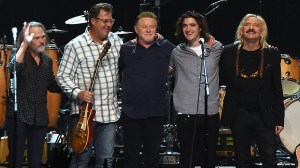
NASHVILLE, TN – OCTOBER 29: Eagles, Timothy B. Schmit, Vince Gill, Don Henley, Decon Frey and Joe Walsh perform during the Eagles in Concert at The Grand Ole Opry on October 29, 2017 in Nashville, Tennessee. (Photo by Rick Diamond/Getty Images) -

NASHVILLE, TENNESSEE – SEPTEMBER 12: Honoree Vince Gill attends CMT Giants: Vince Gill at The Fisher Center for the Performing Arts on September 12, 2022 in Nashville, Tennessee. (Photo by Jason Davis/Getty Images for CMT) -
Photo by Ingrid Fortenberry