There are a handful of Beatles tunes that feature one or some of the band’s members. “Within You Without You” is one such song that features only one Beatle: George Harrison. Released on Sgt. Pepper’s Lonely Hearts Club Band in 1967, this song doesn’t feature the other three members of The Beatles. But it does feature some noteworthy session talent. And they all gathered at Abbey Road Studios on this day, March 15, to record this underrated classic.
The Story Behind George Harrison’s “Within You Without You”, a Beatles Song That Features Only Harrison and Some Session Talent
“Within You Without You” was written by George Harrison, at the time a rare contribution from the guitarist. Traditionally, members Paul McCartney and John Lennon were the main songwriters of the group. And it was clear that the band had been sleeping on Harrison’s talents.
Videos by American Songwriter
“Within You Without You” was Harrison’s second composition that was in the Indian classical style. It was something that he had become inspired by following a 1966 stay in India to learn sitar from Ravi Shankar. The song was recorded at EMI’s Abbey Road Studio 2 in London without the other Beatles. But Harrison didn’t record it alone.
You’ll hear quite a bit of talent on this psychedelic raga rock classic. Harrison takes on the lead vocals, swarmandal (an Indian harp), sitar, tambura (a lute-like instrument), and acoustic guitar.
Anna Joshi and Amrit Gajjar play the dilruba (an Indian bowed instrument) and Buddhadev Kansara and Neil Aspinall (a childhood friend of Harrison who would later head Apple Corps.) play the tambura. Natwar Soni can be heard on the tabla (Indian hand drums) as well. The session musicians just keep coming, including Reginald Kilbey, Allen Ford, and Peter Beavan on cello. A number of violinists also contributed to the track, including Jack Greene, Jack Rothstein, Ralph Elman, David Wolfsthal, Julien Gaillard, Paul Scherman, Erich Gruenberg , and Alan Loveday.
“Within You Without You” would mark a stark divergence from the norm in The Beatles music, as no particularly spiritual or Indian classical songs had made it to the band’s discography. Reception of the song was mixed but leaned positive. Writer Barry Miles put it best in his book, The Beatles Diary: “Some thought it a masterpiece, some a prime example of mock-philosophical babble. Either way, it was pure Harrison.”
Photo by Bettman/Getty Images
Most Viewed
-
LOS ANGELES – 1985: Singer Rosemary Clooney poses for a portrait in 1985 in Los Angeles, California. (Photo by Harry Langdon/Getty Images) -
AUSTIN, TEXAS – Lloyd Maines performs onstage during "Austin City Limits Celebrates 50 Years: A Special Anniversary Taping" of the long-running music series "Austin City Limits" at ACL Live on November 21, 2024 in Austin, Texas. (Photo by Rick Kern/Getty Images) -
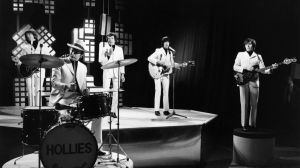
English rock and pop group The Hollies perform the song 'Sorry Suzanne' on the set of the BBC Television pop music television show Top Of The Pops at Lime Grove Studios in London on 27th March 1969. Members of the band are, from left, Tony Hicks, Bobby Elliott, Allan Clarke, Terry Sylvester and Bernie Calvert. (Photo by Ivan Keeman/Redferns) -
Country singer George Morgan portrait circa 1949. (Photo by Michael Ochs Archives/Getty Images) -
Steuart Smith playing with the Eagles -
Portrait of American musician, author, and comedian Kinky Friedman as he poses backstage during the Farm Aid benefit concert at Texas Stadium, Dallas, Texas, March 14, 1992. (Photo by Paul Natkin/Getty Images)