When it comes to brash, in-your-face, angrily patriotic country songs, it’s hard to beat such an intense track like Toby Keith’s “Courtesy of the Red, White, and Blue”. The 2002 track distilled the fear, confusion, and nationalism that followed the 9/11 terror attacks in a way that almost bordered on parody in its fervor, but it became a cornerstone of patriotic country music nonetheless.
However, Keith wasn’t the first to embody this angry, American, largely conservative archetype. In fact, the country singer himself credited Merle Haggard with writing the first ‘angry American’ song decades earlier. Indeed, before there was “Courtesy of the Red, White, and Blue”, there was “The Fightin’ Side of Me”, which Haggard released on the album of the same name. The title track was the album’s first and only single, released on January 26, 1970.
Videos by American Songwriter
The song would invariably link Merle Haggard’s musical legacy with political conservatism, something he would later say he regretted doing with the hit song that preceded “Fightin’ Side”, “Okie from Muskogee”. Even more ironic is the decidedly liberal stance Haggard might have come to adopt if he had released the song he actually wanted to put out instead of “Fightin’ Side of Me”.
Merle Haggard Doubled Down on New Identity With “Fightin’ Side of Me”
Four months before Merle Haggard released “Fightin’ Side of Me” as a single, he put out a similarly conservative track called “Okie from Muskogee” in September 1969. The country music icon would later lament that the song set his career back “about forty years” in an interview with GQ. If that’s true, then “Fightin’ Side of Me” must have added an additional ten. Both songs gave voice to those who still had pride in their country’s potential to be its best. The problem, Haggard argued, were those who took these values to unsustainable extremes.
Speaking of “Fightin’ Side” in a 1988 interview with Spin, Haggard said, “It probably raised more difficulty because it insinuated some kind of violence. To me, it’s a matter of freedom of song. Just like freedom of speech. There’s really no difference. Besides, people who complain about stuff like that are also likely to get on my fightin’ side.”
“Okie” and “Fightin’ Side” effectively squashed any rumors that Haggard held onto any liberal ideology in a way, much to Haggard’s chagrin, that compartmentalized him. Ironically, if Haggard had gotten his way and released the song he wanted to release in place of “Fightin’ Side”, people might have known Haggard was more open-minded than they realized.
The Song That Might Have Pushed Him in a Different Direction
Once Merle Haggard realized that the parodization of the country’s opposing extremes was lost on “Okie from Muskogee” fans, the musician wanted to pull the reins on the conservative runaway train on which he found himself. He suggested a song called “Irma Jackson” to his label, which promptly refused. “Irma Jackson” was the story of a white man in love with a woman he could never have because she was Black. “There’s no way the world will understand that love is colorblind. That’s why Irma Jackson can’t be mine.”
Ken Nelson, who ran Capitol Records’ country music division, stopped Haggard from using “Irma Jackson” as his follow-up to “Okie”. The record executive argued that the world—especially the country world—wasn’t ready to hear a song about interracial relationships. Loving v. Virginia, the Supreme Court decision that officially legalized interracial relationships in the U.S., was hardly three years old.
“Fightin’ Side of Me” won in the end, topping the Billboard Hot Country Songs chart and achieving modest crossover success on the Hot 100, peaking at No. 92. The song remains a favorite among Haggard fans today.
Photo by Lynn Pelham/Getty Images
Most Viewed
-
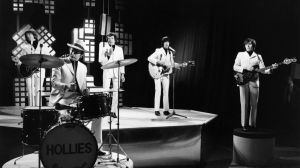
English rock and pop group The Hollies perform the song 'Sorry Suzanne' on the set of the BBC Television pop music television show Top Of The Pops at Lime Grove Studios in London on 27th March 1969. Members of the band are, from left, Tony Hicks, Bobby Elliott, Allan Clarke, Terry Sylvester and Bernie Calvert. (Photo by Ivan Keeman/Redferns) -
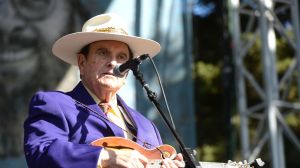
SAN FRANCISCO, CA – Musician Bobby Osborne of the Osborne Brothers performs onstage during the Hardly Strictly Bluegrass music festival at Golden Gate Park on October 7, 2017 in San Francisco, California. (Photo by Scott Dudelson/Getty Images) -
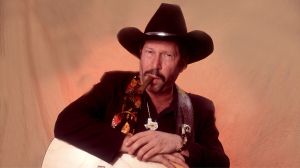
Portrait of American musician, author, and comedian Kinky Friedman as he poses backstage during the Farm Aid benefit concert at Texas Stadium, Dallas, Texas, March 14, 1992. (Photo by Paul Natkin/Getty Images) -
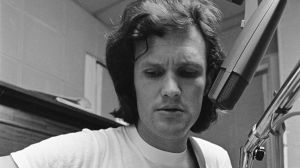
Actor, singer, songwriter, musician, Kris Kristofferson wearing a white T shirtsits on a piano bench with a microphones in front of him while playing an acoustic twelve string guitar at Combine Studios in Nashville, Tennessee in 1970. (Photo by Al Clayton/Getty Images). -
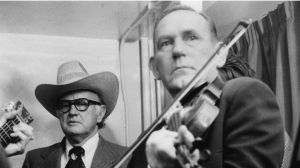
American bluegrass singer and mandolin player Bill Monroe (1911 – 1996, left) backstage at the Hammersmith Odeon, London, with Kenny Baker on the fiddle, 2nd May 1975. (Photo by Sylvia Pitcher/Redferns/Getty Images) -
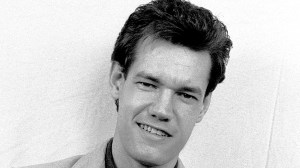
Thirty-nine years ago today, Randy Travis was at the top of the country chart with an award-winning hit inspired by a child learning to pray. -
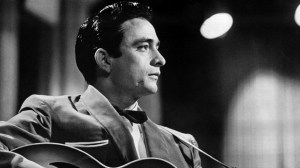
Johnny Cash, who released his debut single 71 years ago today.