
At 15, Suzanne Vega first read American novelist Carson McCullers’ 1963 short story, Sucker, about a teenage boy named Pete, and his younger cousin, Richard (“Sucker”), who idolizes him. And years after reading the book, Vega thought McCullers was a man.
“I thought it was written by a contemporary young male writer, so I kind of forgot about it for a few years,” remembers Vega. When she went to college, Vega was reintroduced to McCullers and became fascinated with the author’s life after reading Virginia Spencer’s 1975 biography, The Lonely Hunter: A Biography of Carson McCullers.
There was an instant connection between Vega and McCullers back then. McCullers reminded Vega of some of the people she grew up with in New York City. Her “aesthetic” and “intensity” also fascinated her, and Vega even recognized a strange resemblance to the Southern Gothic author.
“There was some similarity with how she looked and how she did her hair, and how I did my hair, and this weird thought crossed my mind,” remembers Vega. “I thought, ‘If I ever have to play a character, maybe I could play her, because we look sort of similar.’”
When she started working in the costume department of the school theater, Vega worked up enough courage to start taking acting classes and showed up as McCullers for one homework assignment. Her in-class performance became the root of Vega’s undergraduate thesis at Barnard College in 1981, when she dove deeper into McCullers’s life, one many knew so little about.
Nearly two decades later, Suzanne Vega continued unraveling the novelist’s life, writing and starring in the 2011 Off-Broadway show, Carson McCullers Talks About Love, in New York City, featuring music she had written with Duncan Sheik. The music, which also features a song co-written with Sheik’s longtime collaborator and jazz musician Michael Jefry Stevens, was inspired by McCullers’ life and later released on Vega’s 2016 album, Lover, Beloved: Songs from an Evening with Carson McCullers.
By 2018, Suzanne Vega revived her one-woman show on McCullers, starring in Lover, Beloved, a fictionalized recreation of a talk the author once gave at the 92nd Street Y in New York City, portrayed as two separate monologues throughout her life and set to music.
The performance, directed by Michael Tully, Lover, Beloved—a title pulled from McCullers’ 1951 novella The Ballad of the Sad Cafe and the line, “the lover and the beloved”—premiered at SXSW in 2022 and made its broadcast debut on PBS in February 2026.
McCullers’ life provided plenty of stories for Vega to write around. Diagnosed with rheumatic fever as a child, which led to heart disease, illnesses followed the writer throughout her life, including strokes, breast cancer, and a brain hemorrhage, which ultimately took her life at age 50 in 1967.
“Even as a young child, she seemed somehow marked, to be fated and to be different,” says Vega. “She was a pampered little girl, but the look on her face has this great look of great sadness and suffering and awareness of pain. So that’s what I try to capture.”
Friends with literary figures like Truman Capote and W.H. Auden, burlesque performer, Gypsy Rose Lee, playwrights Tennessee Williams and Edward Albee, McCullers’ artistic world was full of color. And then there was her on-and-off-again marriage to Reeves McCullers, relationships with men and women.
It was challenging for Vega to depict certain elements of McCullers’ character when it came to her tumultuous relationships. “It’s easy to find humor in her more cranky moments,” says Vega. “The song ‘Harper Lee,’ where she’s complaining about her status, that part is great fun, but it was more difficult to bring out the soulfulness and empathy that she had, even though she wasn’t always kind to the people in her life.”
“New York is My Destination,” one of the songs featured on the album and in the new film, was based on one of McCullers’ romances and romanticizations of an artist’s life in New York City. “My instructions to Duncan were to write a song like Rodgers and Hammerstein, something old-fashioned,” recalls Vega. “The music that he came back with was absolutely perfect. I could give him the barest of instructions, and he would come back with something beautifully realized.”
Videos by American Songwriter
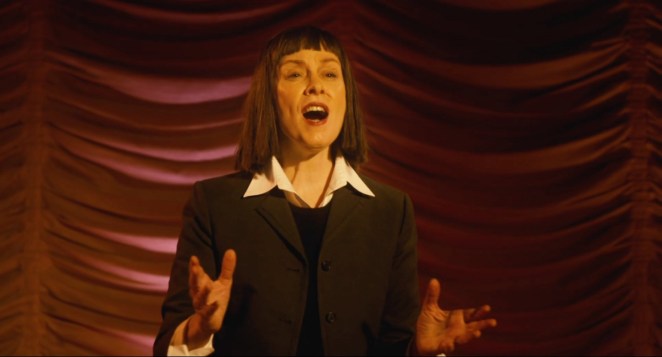
The first part of the performance takes place in 1941, with McCullers drinking her way through a lecture, sharing anecdotes about her illnesses and affairs, then transports 25 years later, as the author reflects on past relationships, her 1946 novel and play, The Member of The Wedding, and confronts her mortality.
With Lover, Beloved complete, Suzanne Vega says she’s open to more acting roles, even though she has been turned down for four major films in the past. She once auditioned for the role of the bohemian drifter in the 1985 film Desperately Seeking Susan, which was later given to Madonna. “I came in to read, and they said ‘You’re too serene for the part,’” remembers Vega. “I thought Madonna did a great job. She was clearly the right person.”
Vega also tried for a spot in the 1986 drama The Color of Money, starring Paul Newman and Tom Cruise. “I walked in, and they looked at me, and said, ‘We thought you were half Puerto Rican,’ and I’m like, ‘Well, my father, who raised me, is Puerto Rican, but my actual dad is like English, Scottish, and Irish.’ So that was the end of my audition, and they got Mary Elizabeth Mastrantonio to do it instead.”
A third audition landed Vega trying out for the Whoopi Goldberg comedy Sister Act, but she was too “Disney” for the role and was asked to lighten it up. Vega said, “No.” She also tried for the 1990 film Miami Blues as a young prostitute, which was ultimately given to Jennifer Jason Leigh.
“I love acting,” says Vega, who also performed in the 2020 off-Broadway production of Bob and Carol and Ted and Alice. With her one-woman show, Vega also hopes to introduce a new generation to McCullers’ work and make others remember it well with Lover, Beloved.
“When her biography came out [in the ’70s], she was considered an American classic, and touted as one of the 100 best American authors of all time,” says Vega. “Though she wrote about the fringes and the alienated people in society, she, herself, was greatly loved in her life. She’d written classic books that we all studied in high school, but over the decades, as I worked on the project, she became farther and farther away, to the point where no one knew her. She’s not even banned because people don’t know her work.”
She continues, “There’s something in the whole persona of Carson McCullers that speaks to the times. I think everything that she wrote about, the way she lived, the problems she faced, has remained contemporary, and even more so now in the political climate that we’re in. I think it may be a moment where her message is needed.”
Photo: Courtesy of PBS
More Interviews
-

NASHVILLE, TENNESSEE – SEPTEMBER 12: Honoree Vince Gill attends CMT Giants: Vince Gill at The Fisher Center for the Performing Arts on September 12, 2022 in Nashville, Tennessee. (Photo by Jason Davis/Getty Images for CMT) -
Photo by Ingrid Fortenberry -

Photo by Tibrina Hobson/Getty Images