
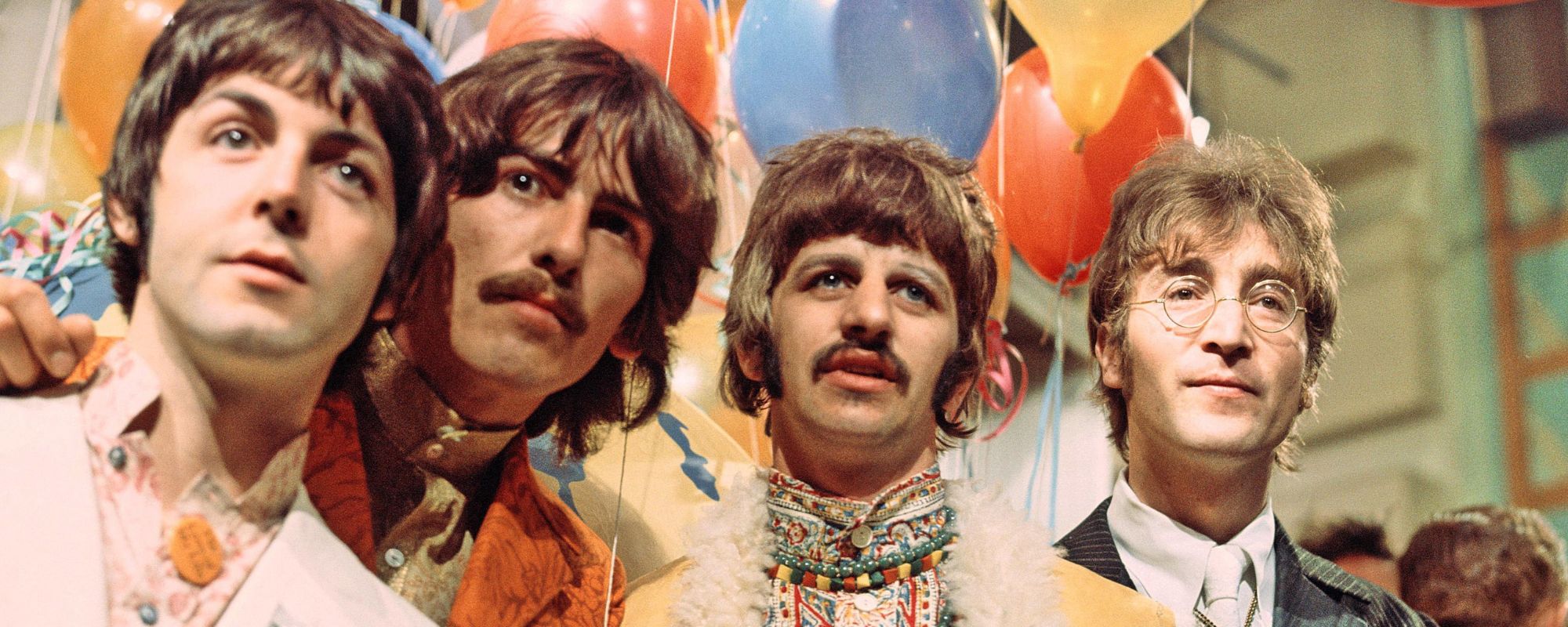
The Beatles might have officially broken up around 1970, but John Lennon was signaling his departure to his bandmates years before they legally finalized their separation. Of all the members of the Fab Four, Lennon was perhaps the most psychedelically sardonic songwriter of the bunch, hiding double meanings, red herrings, and covert messaging into his lyrics.
Videos by American Songwriter
In the 1968 “White Album” track, “Glass Onion,” Lennon managed to incorporate all three while simultaneously—and perhaps subconsciously—hinting at his desire to quit the band.
John Lennon Used This Song To Signal Upcoming Departure
Fame comes with a certain set of creative disadvantages, and one notable pitfall that the Beatles encountered often was their audience’s tendency to voraciously pore over lyrics and melodies to harvest new, deeper meanings about the bandmates, their relationships with one another, and their connections to the rest of the world. One could argue that this kind of intense interest is something any musician should strive for. However, one could also counter-argue that the constant search for hidden meaning can pick apart the music until it’s no longer the original art the Beatles intended to make.
At least, John Lennon seemed to think as much. In “Glass Onion,” the third track off the Beatles’ 1968 eponymous album, Lennon references several Fab Four tracks from the past few years. The song includes references to “Strawberry Fields Forever,” “Lady Madonna,” “Fool on the Hill,” and “Fixing a Hole.” Lennon also includes a callback to the Magical Mystery Tour track, “I Am the Walrus,” singing, I told you about the walrus and me, man. You know that we’re as close as can be, man. Well, here’s another clue for you all. The walrus was Paul.
In some interviews, Lennon explained the references by saying he wanted to make it as confusing as possible for the listener to glean more meaning from the track. But in one of his final interviews with David Sheff, Lennon admitted, “The line was put in partly because I was feeling guilty because I was with Yoko, and I was leaving Paul. I was trying…I don’t know. It’s a very perverse way of saying to Paul, you know, ‘Here, have this crumb, this illusion, this, this stroke, because I’m leaving.”
It Wasn’t The First Time He Purposefully Misled His Listeners
Whether John Lennon consciously or subconsciously knew he was saying goodbye to his long-time friend and bandmate with “Glass Onion,” it certainly wasn’t the only time that the “witty” Beatle used his songwriting to misguide and divert his audience. In fact, he did the very same thing with one of the songs he referenced in “Glass Onion,” “I Am the Walrus.”
A student at Lennon’s alma mater, Quarry Bank, sent the Beatle a letter explaining that the school had started analyzing Lennon’s lyrics as part of its literature curriculum. Lennon, who didn’t have particularly fond memories of his time at school, decided to have a little fun with this newfound knowledge.
“John and I howled in laughter over the absurdity of it all,” Lennon’s friend, Pete Shotton, recalled in his book The Beatles, Lennon, and Me. “Inspired by the picture of that Quarry Bank literature master pontificating about the symbolism of Lennon-McCartney, John threw in the most ludicrous images his imagination could conjure. He turned to me, smiling. ‘Let the f***ers work that one out, Pete.”
Lennon might have scoffed at the idea that his lyrics held any deeper meaning than being plain ol’ rock ‘n’ roll, but the sheer lengths he took to subvert and distract the audience are meaning enough on their own. When you’re a true artist, you create art, even if you’re actively trying not to do so.
Photo by Harry Benson/Express/Hulton Archive/Getty Images






Leave a Reply
Only members can comment. Become a member. Already a member? Log in.