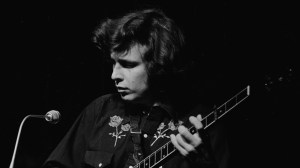
On this day (May 15) in 1965, Bob Dylan’s “Subterranean Homesick Blues” peaked at No. 39 on the Billboard Hot 100. It was the now-legendary singer/songwriter’s first single to break the top 40 in the United States. Moreover, it was his first single to reach the Hot 100, despite releasing two previous songs that would become cultural touchstones in the years to come.
Dylan is one of those artists who prove that chart success and quality aren’t always the same thing. His first three singles failed to chart. Decades later, they’re hailed as classics. First, he released “Mixed-Up Confusion” backed with an early cut of “Corina Corina.” He followed that with “Blowin’ in the Wind” backed with “Don’t Think Twice It’s All Right.” His third single was “The Times They Are a-Changin’” with “Honey, Just Allow Me One More Chance” on the B-Side.
Videos by American Songwriter
“Subterranean Homesick Blues” didn’t kick off a line of major hits for Dylan. It did, however, mark the beginning of a period of moderate chart success.
Bob Dylan Made Waves with “Subterranean Homesick Blues”
While “Subterranean Homesick Blues” was barely a top 40 hit for Bob Dylan, it made waves in American culture and beyond. For instance, it shook John Lennon to his core. According to Songfacts, he was so stunned by the song that he worried he’d never be able to write anything that would compete with it.
The song stuck with the former Beatle. He quoted it during a 1980 interview. “Listen, there’s nothing wrong with following examples. We can have figureheads and people we admire, but we don’t need leaders,” he said. “Don’t follow leaders, watch the parking meters,” he added, quoting a line from the track.
Another line struck a handful of people a few years later. The line “You don’t need a weatherman to know which way the wind blows” impacted Bill Ayers and Bernardine Dohrn, who were the leaders of the Weather Underground Organization. They were also known as the Weathermen. The lyric was also the title of their manifesto. The militant group was connected to a series of bombings in the late 1960s and early ’70s.
Featured Image by Bettmann/Getty Images
-
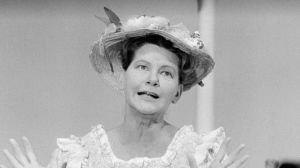
American country comedienne Minnie Pearl (1912 – 1996) performing, circa 1970. (Photo by Silver Screen Collection/Getty Images) -
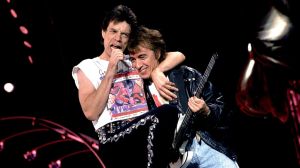
British musicians Mick Jagger (left) and Bill Wyman of the Rolling Stones performs on stage during the band's 'Steel Wheels' tour, late 1989. (Photo by Paul Natkin/Getty Images) -
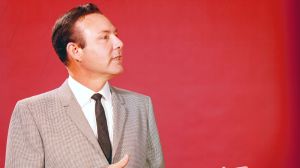
UNSPECIFIED – CIRCA 1970: Photo of Jim Reeves Photo by Michael Ochs Archives/Getty Images -
NASHVILLE, TN – Singer/Songwriter Whitey Shafer performs during the All-Star Whitey Shafer Benefit, Hosted By Moe Bandy at The Nashville Palace on March 18, 2015 in Nashville, Tennessee. (Photo by Rick Diamond/Getty Images for Webster PR) -
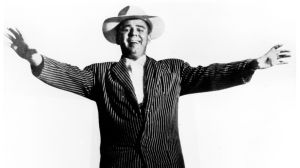
American singer, songwriter and disc jockey The Big Bopper, circa 1955. (Photo by Michael Ochs Archives/Getty Images)