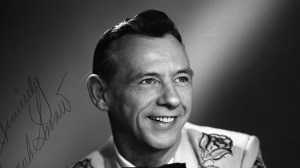
A prominent figure on the post-World War II Western swing scene, Tex Williams is best known for the laconic novelty hit “Smoke! Smoke! Smoke! (That Cigarette)” Co-written with Merle Travis and released in 1947, the song spent 16 weeks atop Billboard’s Hot Country Songs chart. More than six decades later, “Smoke” served as the title song for the 2005 satirical film Thank You for Smoking.
Today, we’re exploring the life and career of Sollie Paul “Tex” Williams. He was born in Ramsey, Illinois, on this day (August 23) in 1917.
Videos by American Songwriter
Tex Williams Helped Deliver Country Music to a Much Wider Audience
The youngest of 11 children, Tex Williams learned folk and traditional music from his father, a fiddler who operated a sawmill and blacksmith shop in Ramsey. By age 13, he had his own one-man band program on a local radio station.
During the height of World War in the early 1940s, California was seeing an influx of defense workers from Texas and Oklahoma.
This created a demand for Western swing entertainment on the West Coast. That was good news for Williams when he moved to Los Angeles in 1942. He quickly found a vocalist spot with Western swing bandleader Spade Cooley’s group. Williams sang on the band’s number-one hit, “Shame On You”, in 1945.
Going His Own Way
In 1946, Capitol Records offered Tex Williams a solo contract. This strained his relationship with the already volatile Cooley to its breaking point, and the bandleader fired him in June of that year.
Williams left, taking most of Cooley’s band with him. He formed his own 12-piece band, the Western Caravan.
The group scored their first hit when their recording of “The California Polka” reached number four on the Billboard folk chart.
His Biggest Hit
In July 1947, Tex Williams released the novelty song “Smoke! Smoke! Smoke! (That Cigarette)”, which he’d co-written with Hall of Fame singer-songwriter Merle Travis.
The song’s lyrics take direct aim at the tobacco industry, decrying the irresistible pull that their main product has on smokers. But nicotine slaves are all the same / At a pheasant party or a poker game / Everythin’s gotta stop when they have that cigarette.
“Smoke” spent 16 non-consecutive weeks at number one on the country songs chart in 1947. Since then, artists like Willie Nelson, Asleep at the Wheel, and Hank Thompson have covered it.
While Williams never reached the pinnacle again, he did collect more top 10 hits. Those include “Don’t Telephone – Don’t Telegraph (Tell a Woman)” and “Life Gets Tee-Jus Don’t It”.
Tex Williams also landed roles in about 25 short movies, including Cheyenne Cowboy and The Pecos Pistol (both 1949).
In the 1950s, he hosted The Tex Williams Show on a local Los Angeles TV station. He also opened the Tex Williams Nightclub in Newhall, Santa Clarita, California — where he spent the last 27 years of his life.
He Didn’t Die of Lung Cancer, Contrary to Popular Belief
Due to the subject matter of Tex Williams’ signature hit, many assumed that lung cancer was what ultimately claimed his life.
And while he was a heavy smoker — reportedly going through two packs a day — Williams ultimately succumbed to kidney failure on October 11, 1985 at Newhall Community Hospital.
He was 68 years old.
Featured image by Michael Ochs Archives/Getty Images
-

UNITED KINGDOM – JANUARY 01: WEMBLEY ARENA Photo of Johnny DUNCAN (Photo by David Redfern/Redferns) -

LONDON, UNITED KINGDOM – Loretta Lynn performs on stage at the Country Music Festival held at Wembley Arena, London in April 1985. (Photo by David Redfern/Redferns) -

LONDON, UNITED KINGDOM – APRIL 01: Steel guitar player Lloyd Green performs on stage at the Country Music Festival held at Wembley Arena, London in April 1982. (Photo by David Redfern/Redferns) -

DOLLY PARTON'S COAT OF MANY COLORS — Pictured: Dolly Parton — (Photo by: Quantrell Colbert/NBCU Photo Bank/NBCUniversal via Getty Images via Getty Images) -
UNSPECIFIED – JANUARY 01: Photo of Le Roy Van Dyke (Photo by Michael Ochs Archives/Getty Images) -

American guitarist Lindsey Buckingham performing with Fleetwood Mac at Nassau Coliseum, Uniondale, New York, 26th March 1977. (Photo by Michael Putland/Getty Images) -

Waist-up photo of American folk singer and composer Woody Guthrie (1912-1967) playing his guitar. Ca. 1960s. (Photo by �� John Springer Collection/CORBIS/Corbis via Getty Images)