In many ways, country music originated on this day (November 20) in 1887. That’s also the day that Alexander Campbell “Eck” Robertson was born in Delaney, Arkansas. Coming from a long line of fiddlers, Robertson made history on June 30, 1922, when he stepped into a New York City studio to record four fiddle duets with Henry C. Gilliland for the Victor Talking Machine Company. Two of those duets—”Arkansas Traveler” and “Turkey in the Straw”—would become the first-ever commercial country music recordings released into the world.
Although Eck Robertson continued playing the fiddle well into his 70s, he never did quite get his due from the industry he helped created before his death on February 15, 1975, in Borger, Texas, at age 87. Today, we’re shining a light on Robertson’s contributions in honor of what would have been his 139th birthday.
Videos by American Songwriter
Eck Robertson Was “a Natural-Born Fiddler”
Although born in Arkansas, Eck Robertson lived most of his life in the Lone Star State. When he was just three years old, his family moved to the Texas Panhandle, settling on a farm outside Amarillo where Robertson would spend his childhood.
Fiddling was in his DNA, and his father, grandfather, and uncles often showcased their talents in local competitions. Robertson himself first picked up the instrument at just five years old.
“I’m just a natural born fiddler, I reckon,” he said in a 1972 interview with JEMF Quarterly.
Turning Pro
His father—a Civil War veteran—eventually quit fiddling to become a preacher. Eck Robertson, however, kept at it, leaving home at 16 to travel with a medicine show through Indian Territory.
He married childhood friend Nettie Levy in 1906 and settled in Vernon, Texas, where he found work as a piano tuner for the Total Line Music Company. Robertson and wife Nettie also performed at silent film theaters and fiddling contests across the southwestern U.S.
Eventually, he linked up with professional fiddler Henry C. Gilliland, in his seventies at the time. The two took their act on the road, traveling to New York City in June 1922 to audition for the Victor Talking Machine Company.
Gilliland leveraged his friendship with lawyer Marvin Littleton, who represented Victor, to finagle a recording contract for the duo. This resulted in the session that produced “Arkansas Traveler” and “Turkey in the Straw”.
The following day, Robertson returned to the studio alone—decked out in full Western regalia—to record six more tunes, including “Sallie Gooden”.
The Victor Company issued a limited release of “Arkansas Traveler” and “Sallie Gooden” in September 1922. However, the disc did not circulate more widely until April of the following year.
What Came Next?
After a seven-year break in 1929, Eck Robertson recorded again with the Victor Company in Dallas. However, he saw limited success due to the stock market crash and ensuing contract disputes with Victor.
The week of September 20, 1940, Robertson recorded 100 fiddle tunes at Jack Sellers Studios in Dallas, Texas. Unfortunately, those recordings have seemingly been lost to history.
Robertson continued performing at dances, theaters, fiddlers’ conventions and on radio. He even made an appearance at the Newport Folk Festival in 1965, sharing a billing with Joan Baez, Donovan, Lightnin’ Hopkins, and more.
Until his death in 1975, Eck Robertson maintained that he felt slighted by Victor. “It got to where they’d beat me out of every damn thing,” he told JEMF Quarterly. “Every time I’d put out a record, they’d beat me out of hundreds of
dollars on it.”
Still, Robertson’s work continues to resonate with those who carry on his craft. Speaking to Texas Highways magazine, Austin fiddler Erik Hokkanen dubbed Robertson “the patriarch of the Texas fiddle style.”
[RELATED: 15 Songs That Showcase the Evolution of Country Music]
“A hundred years later and nobody’s topped him,” Hokkanen said.
Featured image by DeAgostini/Getty Images
-

RALEIGH, NORTH CAROLINA – JUNE 02: TJ Osborne of Brothers Osborne performs during a concert prior to Game One of the 2026 Stanley Cup Final between the Vegas Golden Knights and the Carolina Hurricanes at Lenovo Center on June 02, 2026 in Raleigh, North Carolina. (Photo by Jaylynn Nash/Getty Images) -

Steel Guitar Hall of Fame member John Hughey, December 27, 1933 – November 18, 2007 (Photo courtesy of Facebook) -

Photo taken in Dallas just before the Dixie Chicks released their album "Shouldn't a Told You That." From left, Emily Erwin, Laura Lynch and Martie Erwin. (Ralph Lauer/Fort Worth Star-Telegram/Tribune News Service via Getty Images) -
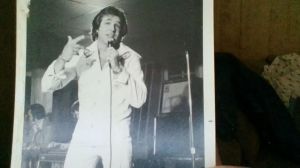
Country singer Jacky Ward, born November 18, 1946, in Groveton, Texas. (Photo Country singer Jacky Ward, born November 18, 1946, in Groveton, Texas. (Photo courtesy of Facebook))