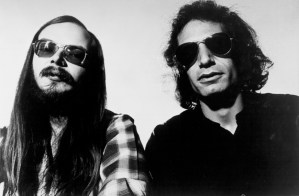
The general masses love to hear music that relates to their experiences outside of excess wealth and luxury. But if an artist or band has a big enough platform to reach the general masses, then chances are, they’re richer than their blue-collar lyrics might suggest. It’s a paradox as old as time, and one that we’ve only enhanced with discourse around nepo babies and financial safety nets. Not even the rough-and-tumble world of rock ‘n’ roll is immune to this age-old contradiction, and that includes Pink Floyd.
Pink Floyd’s distinct blend of psychedelia and sociopolitical commentary made them a fast favorite in the 1970s, and a song like “Money” off Dark Side of the Moon perfectly encapsulated this kind of self-aware wit, cynicism, and unique groove. The song was a hit, and that was something worth celebrating. However, that track also turned the band into, for lack of a better word, hypocrites, and that was a tough pill to swallow.
Videos by American Songwriter
Pink Floyd’s Connection to “Money” Changed After 1973
Pink Floyd turned into a massive, worldwide success in the 1970s, but the British psychedelic rock band had been cutting their teeth for years prior. They were no strangers to the “starving artist” lifestyle, ever since they began playing music together while studying at university. But after 1973, Pink Floyd was catapulted out of obscurity into a level of stardom and ubiquity they could never retrieve. Dark Side of the Moon was one of the most successful albums of the entire decade. To say it was a success is an understatement. Dark Side was an entire cultural phenomenon.
The band released two singles off Dark Side of the Moon, “Money” and “Us and Them”. The former track’s hypnotic, 7/8 groove and sardonic lyrics about the hypocrisy and pitfalls of wealth made it an instant classic in the States. “Money” broke into the Top 20 of the Billboard Hot 100. (Even today, it remains a staple in classic rock radio rotations worldwide.) The 1973 track marked Pink Floyd’s first hit in the U.S.
“We were by no means rich at that time,” David Gilmour later told Uncut. But by the end of 1973, they were certainly close. In the years that followed, the band’s breakthrough hit in the States became, ironically, “the track that made us guilty of what it propounds, funnily enough.”
Suddenly, the band was flying around the world in a Learjet, squabbling over money, and hoarding it in great amounts. In a way, the song’s final verse beautifully illustrates this transformation.
“Money, so they say, is the root of all evil today / But if you ask for a rise, it’s no surprise that they’re giving none away.”
Photo by Michael Ochs Archives/Getty Images
More Behind The Song
-
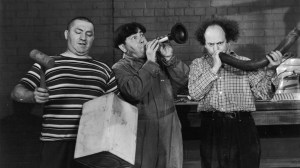
circa 1940: The Three Stooges turn plumbing equipment into musical instruments in a still from an unidentified film. L-R: Curly Howard (1903 – 1952), Moe Howard (1897 – 1975) and Larry Fine (1902 – 1975). (Photo by Hulton Archive/Getty Images) -

TODAY — Pictured: Keith Urban on Thursday, August 2, 2018 — (Photo by: Nathan Congleton/NBCU Photo Bank/NBCUniversal via Getty Images via Getty Images) -
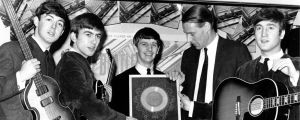
LONDON – 1964: Rock and roll band "The Beatles" poses for a portrait with their producer George Martin. (L-R) Paul McCartney, George Harrison, Ringo Starr, producer George Martin, John Lennon. (Photo by Michael Ochs Archives/Getty Images) -
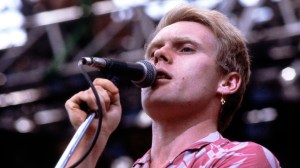
Musician Dave Wakeling, founder of 'The English Beat' performs before thousands of rock fans at the US Festival, May 29,1983 in Devore, California. (Photo by Bob Riha, Jr./Getty Images) -
Miranda Lambert performs "Kerosene" at the Madison Square Garden in New York City, New York (Photo by Rick Diamond/WireImage) -
British singer Dusty Springfield (1939 – 1999) performing during a rehearsal for her TV show, 'It Must Be Dusty', at ATV Studios in Borehamwood, Hertfordshire, 1968. (Photo by Keystone/Hulton Archive/Getty Images) -
NITED STATES – JANUARY 01: Photo of Joe COCKER; Joe Cocker performing on stage (Photo by Robert Knight Archive/Redferns)