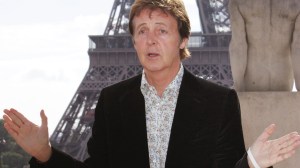
Music and sports are two of America’s great obsessions. Rarely have the two pastimes crossed paths so seamlessly as in the Simon & Garfunkel song “Mrs. Robinson”. Paul Simon, a lifelong baseball fan, helped make that happen.
Not everyone understood, however, what Simon was getting at when he mentioned baseball legend Joe DiMaggio in the lyrics to the song. As it turned out, that included DiMaggio himself.
Videos by American Songwriter
The Origin of a Hit
When you watch The Graduate, the hit 1967 film that utilizes the music of Simon & Garfunkel, you’ll hear a version of “Mrs. Robinson” that you might not recognize if all you know is the hit single. That’s because the movie version wasn’t much more than a stand-in.
Mike Nichols, the director of the film, came to the duo looking for songs for the film. When their first few submissions didn’t exactly set the director on fire, he asked if they had anything else. They offered a snippet of a song originally called “Mrs. Roosevelt”. Only they changed the name to coincide with the character’s name in the film.
Nichols loved it, and the duo recorded a brief version with “doo-doo” and “dee-dee” syllables in the verses because the lyrics hadn’t really been written yet. Even the refrain was different from the ones included in the final version, one of which name-checked an all-time baseball great.
A Callback to Joe
Joe DiMaggio stood out as one of the heroes of the golden age of baseball, his exploits in the 40s and 50s with the New York Yankees the stuff of legend. Simon was trying to make a point in the song about the generation gap. He thought DiMaggio was the perfect person to reference when talking about bygone heroes.
Hence the lines from the finished version of “Mrs. Robinson”, which finally came out as a single in 1968: “Where have you gone, Joe DiMaggio?/A nation turns its lonely eyes to you/What’s that you say, Mrs. Robinson?/Joltin’ Joe has left and gone away.” The song became a runaway No. 1 single.
In a way, the song introduced DiMaggio to a younger group of fans who were tuned to the pop music of the day and didn’t know much about baseball from a decade or two before. But DiMaggio didn’t quite see it in a positive light, at least not initially.
Simon’s Explanation
Joe DiMaggio’s views on “Mrs. Robinson” changed when he had a chance restaurant encounter with Paul Simon. At first, DiMaggio questioned Simon’s accuracy, claiming that he (DiMaggio) hadn’t gone anywhere. It was then that Simon explained the symbolism he was after, helping the baseball great understand and appreciate the mention.
Meanwhile, another New York Yankee great also had an issue with “Mrs. Robinson.” Simon’s actual era of baseball fandom more closely coincided with the heyday of Mickey Mantle. Knowing this, Mantle wondered why he wasn’t chosen to be immortalized in “Mrs. Robinson”.
Simon explained to Mantle that his name simply didn’t work within the poetic meter of the song. The musician later made it up to Mantle by including him in a 1988 video for Simon’s early 70s smash “Me And Julio Down By The Schoolyard”.
(Photo by CBS via Getty Images)
More Behind The Song
-
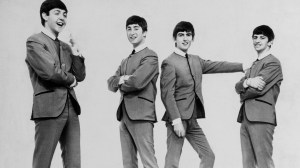
Promotional studio portrait of The Beatles, Paul McCartney, John Lennon, George Harrison and Ringo Starr, 1963 (Photo by Daily Herald Archive/National Science & Media Museum/SSPL via Getty Images) -
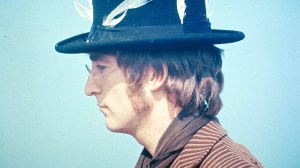
John Lennon (1940-1980) of English rock and pop group The Beatles, wearing a hat decorated with feathers, takes part in filming of the television musical film 'Magical Mystery Tour' in a field near Newquay, Cornwall on 14th September 1967. (Photo by David Redfern/Redferns) -
Photo by Disney General Entertainment Content via Getty Images -
Photo by Koh Hasebe/Shinko Music/Getty Images -

Photo by Christian Rose/Roger Viollet via Getty Images -
Photo by Lynn Goldsmith/Corbis/VCG via Getty Images -
Photo by kpa/United Archives via Getty Images