
The best bands possess the knack for giving listeners what they don’t realize they wanted until they’ve heard it. That requires a willingness to occasionally change approach from the way that they’ve done things in the past.
Few bands ever shifted gears with as much skill as Talking Heads. In 1985, they offered perhaps their most radical departure yet. That’s when this famously adventurous quartet made an album that aimed for the pop music mainstream.
Videos by American Songwriter
Heads Roll
Talking Heads emerged in 1977 with their debut album just a few years after their formation in New York City. By that time, they’d established themselves as darlings of the CBGB’s crowd thanks to their off-kilter, uncategorizable approach to rock.
But the mainstream mostly kept them at arm’s length. Even when they were releasing stellar LPs, à la Remain In Light, their critical acclaim far outpaced their commercial recognition. As the 80s progressed, however, that started to change thanks to the advent of MTV. Due to its need for programming, the network unleashed a whole slew of forward-thinking acts on viewers from all over the country.
Talking Heads parlayed that into their first US Top 10 single, “Burning Down The House”, in 1983. A year later, Stop Making Sense, a stunning concert film, pushed them to a new level of adulation among discerning rock fans. There couldn’t have been a more opportune time for them to go big and court pop fans with their next release.
‘Creatures’ Comfort
Perhaps David Byrne sensed that the moment to strike was nigh. On past Talking Heads albums, the band, which also included Jerry Harrison, Tina Weymouth, and Chris Frantz, tended to work out the music together in the studio, often joining their disparate instrumental parts in surprising ways.
But for the album that would be named Little Creatures upon its release in 1985, Byrne came into the studio with demos of the songs that he’d written. It meant that there’d be less of an experimental vibe to the sessions.
The decision by the band to produce the album themselves also seemed to strengthen the idea they’d be going for a more approachable feel to the music. In other words, there was no Brian Eno around taking the songs into fascinatingly weird places. Add to that the fact that Byrne’s demos were more straightforward in terms of verse-chorus structure. Weymouth’s harmony vocals were also more prevalent than ever before.
That’s not to say the band completely abandoned their explorative tendencies. On “Road To Nowhere”, for example, accordion and washboard were applied to give the song a zydeco feel. Guest Eric Weissman’s steel guitar on “Creatures Of Love” and “Walk It Down” emphasized the rootsy turn in Byrne’s writing.
MTV Darlings
Little Creatures, released in June 1985, certainly represented a more traditional version of Talking Heads (which was still multiple times quirkier than your average rock band). Some of the old gonzo unpredictability was missing. But they traded that in for direct hits on the pleasure centers of their listeners.
Even though they weren’t big pop hits, the singles “Road To Nowhere”, “And She Was”, and “Stay Up Late” were all over MTV. The album sold well, even if some critics bemoaned the relative lack of ambition on the record.
Talking Heads made just two more albums before their breakup. Much to the consternation of their fanbase, they’ve never reunited to make new music. Looking back at Little Creatures, it’s by far and away their most instantly accessible album, even if it might not reward repeat listens as well as some of its bolder predecessors in the band’s catalog.
Photo by Aaron Rapoport/Corbis/Getty Images
More Features
-
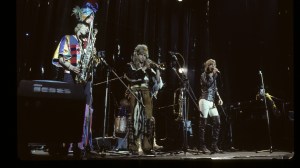
IN CONCERT – From London – Shoot Date: June 13, 1974. (Photo by ABC Photo Archives/ABC via Getty Images) BLUE SWEDE -
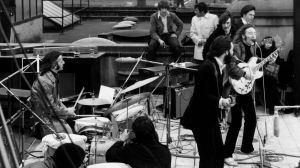
30th January 1969: British rock group the Beatles performing their last live public concert on the rooftop of the Apple Organization building for director Michael Lindsey-Hogg's film documentary, 'Let It Be,' on Savile Row, London, England. Drummer Ringo Starr sits behind his kit. Singer/songwriters Paul McCartney and John Lennon perform at their microphones, and guitarist George Harrison (1943 – 2001) stands behind them. Lennon's wife Yoko Ono sits at right. (Photo by Express/Express/Getty Images) -
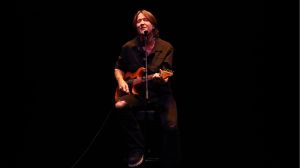
MELBOURNE, AUSTRALIA – Keith Urban performs during "The Songs Of John Farnham, The Celebration Concert" at Rod Laver Arena on September 20, 2026 in Melbourne, Australia. (Photo by Graham Denholm/Getty Images) -
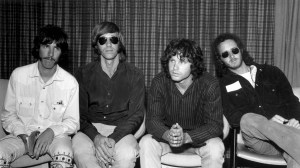
3rd September 1968: American psychedelic rock band, The Doors during a press conference at Heathrow Airport, London (left to right); drummer John Densmore, keyboard player Ray Mansarek, vocalist Jim Morrison (1943 – 1971) and guitarist Robby Krieger. (Photo by Central Press/Getty Images) -
Australian-American singer, songwriter, author, actress, and activist Helen Reddy (1941 – 2020), 1975. (Photo by Tony Russell/Redferns) -
Original Caption) : 1980-Pop singer Linda Ronstadt is shown singing on stage, holding the microphone stand. She wears a gingham shirt with a tie front and askirt with flowers on it in this waist-up portrait. (Photo by Lynn Goldsmith/Corbis/VCG via Getty Images) -
Tears for Fears – Koninklijk Circus – Brussel – Belgium – 21/04/1985 Roland Orzabal, Curt Smith Photo gie Knaeps -
The Rolling Stones at Desert Trip