Your cart is currently empty!



Remember When Sinéad O’ Connor Covered Dolly Parton and Loretta Lynn, and Shared a Duet With Willie Nelson
In 1995, Sinéad O’Connor left another atmospheric touch to Bobbie Gentry‘s 1967 Southern country-folk hit “Ode to Billie Joe” for the charity compilation Help: A Charity Project for the Children of Bosnia, featuring additional contributions by Johnny Depp and Oasis, Radiohead, Manic Street Preachers, Paul Weller, and more.
Originally written by Gentry, the somber ballad was the title track of her debut album in 1967, which went to No. 1 on the Billboard Hot 100, won three Grammy Awards, and was later adapted into a film of the same name in 1976.
“Anyone who hears the song can think what they want, but the real message of the song, if there must be a message, revolves around the nonchalant way the family talks about the suicide,” shared Gentry of the song in 2005. “They sit there eating their peas and apple pie and talking, without even realizing that Billie Joe’s girlfriend is sitting at the table, a member of the family.”
Just two years earlier, O’Connor pushed deeper into the genre, covering a country legend, then shared a duet with another in 1993. A decade later, her country path also crossed with Dolly Parton.
Videos by American Songwriter
[RELATED: Dolly Parton’s Heartfelt Letter to Sinéad O’Connor]
Loretta Lynn and O’Connor’s “Success”
In 1992, O’Connor first moved into the country genre with a cover of Loretta Lynn‘s first Top 10 hit, her 1962 single “Success.” Released on O’Connor’s third album, I Am Not Your Girl, and retitled “Success Has Made Me a Failure of Our Home,” the song was co-produced with Phil Ramone and became one of the Irish singer’s biggest hits, peaking at No. 20 on the Billboard Alternative Songs chart.
Written by Johnny Mullins, who also penned Lynn’s 1965 hit “Blue Kentucky Girl,” “Success” was recorded as the opening track of the country legend’s 1962 debut album Loretta Lynn Sings and went to No. 6.
Reflecting on the abuse she suffered from her mother as a young child, O’Connor considered the song the most personal one she recorded on I Am Not Your Girl.
“That’s definitely the most biographical song on the album, the one that is the most personal,” said O’Connor. “I didn’t see it in terms of being a country song, even though Loretta Lynn recorded it, but as a song that expressed something important, how everyone is concerned with material success and what that can do to people. Success has made a failure of our home, my home.”
Covering Peter Gabriel with Willie Nelson; Dolly’s “Dagger Through My Heart”
Before O’Connor took on the Gentry classic, she also found herself recording a duet with Willie Nelson. The duo recorded a stirring version of Peter Gabriel‘s “Don’t Give Up” for Nelson’s album, Across the Borderline, a collection of interpretations of songs by Paul Simon, Bob Dylan, Willie Dixon, and Lyle Lovett, among others.
Originally written by Gabriel, “Don’t Give Up” was released as a duet with Kate Bush on his 1986 album, So. For their rendition, Nelson and O’Connor also filmed a cinematic music video for the track.
Nearly a decade later, O’Connor took on another country legend, delivering a more bluegrass and folk touch to Dolly Parton‘s 2002 song “Dagger Through the Heart.” The song was originally released on Parton’s 39th album, Halos & Horns, but O’Connor’s version was later featured on a 2003 tribute compilation to the country legend entitled Just Because I’m a Woman: Songs of Dolly Parton.
Coincidentally, “Dagger Through the Heart” was also the first song O’Connor performed during her infamous 1992 performance on Saturday Night Live. Parton’s song opened her SNL set, before an a cappella rendition of Bob Marley‘s 1976 song “War,” both performed prior to her tearing a photo of Pope John Paul II.
Shortly after the release of the new version of “Dagger Through the Heart,” Parton, who hand-picked O’Connor to cover the track for a tribute album, showed her appreciation for the cover and wrote her a note.
“Well, I have always loved you anyhow, but now I love you more,” wrote Parton. “I absolutely love how you sang ‘Dagger Through the Heart.’ Man alive, I feel that through and through. Thank you for being a part of this special project and for giving so generously of yourself and your talent.”
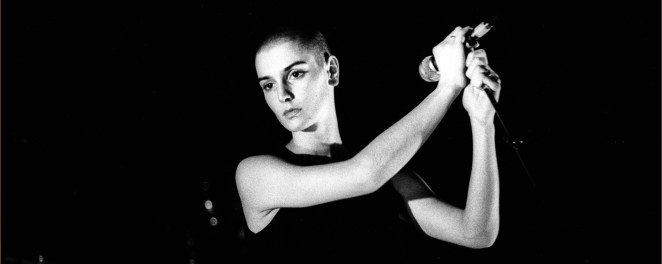
Photo: Sinead O’Connor, Vredenburg in Utrecht, Netherlands, March 16, 1988. (Frans Schellekens/Redferns)
Leave a Reply
Only members can comment. Become a member. Already a member? Log in.